
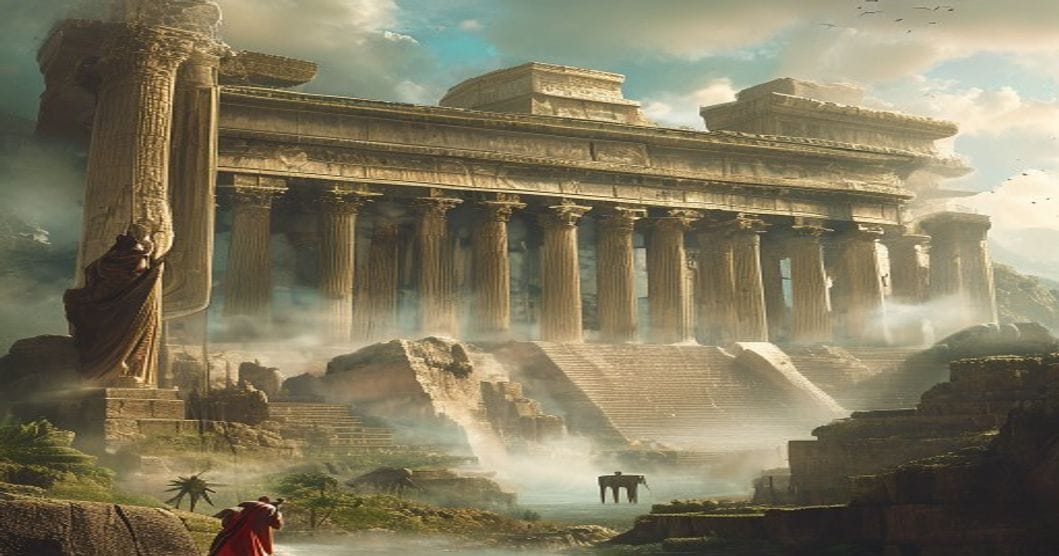

The history of ancient civilizations is filled with tales of lost worlds and forgotten empires—the most enigmatic of which remains Atlantis.
The history of ancient civilizations has long fascinated scholars and dreamers alike, but none have captured the imagination quite like Atlantis. This legendary island, said to have vanished beneath the waves in a single day, stands as a testament to humanity’s enduring fascination with the unknown. First introduced to the world by the Greek philosopher Plato in 360 BCE, the story of Atlantis has sparked centuries of debate, speculation, and adventure. Was it a real place destroyed by divine wrath, or merely an allegory crafted to illustrate the dangers of hubris? As we delve into the history of ancient civilizations, the mystery of Atlantis remains one of its most compelling unsolved riddles.
The allure of Atlantis lies not just in its dramatic demise but in the tantalizing clues scattered across ancient texts, archaeological findings, and cultural traditions. From Plato’s vivid descriptions to modern theories linking Atlantis to the Minoan civilization or even Antarctica, the story has evolved into a global phenomenon. Its themes of advanced technology, utopian society, and catastrophic collapse resonate with contemporary concerns about environmental disaster and societal decline. For historians, archaeologists, and enthusiasts of the history of ancient civilizations, Atlantis represents both a challenge and an invitation—to separate myth from reality and uncover truths hidden beneath the ocean’s surface.
The Origins of the Atlantis Myth in Ancient Texts
The history of ancient civilizations shows that myths often emerge from a blend of historical events, cultural beliefs, and political agendas. The story of Atlantis is no exception. While Plato’s dialogues, Timaeus and Critias, are the primary sources, the seeds of the legend may have been sown much earlier. Some scholars suggest that the myth originated from earlier Egyptian or Phoenician traditions, possibly transmitted through the travels of Solon, the Athenian lawgiver, who is said to have heard the tale during his visit to Egypt around 590 BCE.
Ancient texts from diverse cultures hint at lost civilizations or deluges that mirror the Atlantis narrative. The Epic of Gilgamesh, one of the earliest known works of literature, describes a great flood sent by the gods to destroy humanity. Similarly, Hindu and Norse myths feature submerged worlds and divine retribution. The history of ancient civilizations reveals that these stories often served as moral lessons or explanations for natural disasters. In the case of Atlantis, Plato’s version stands out for its detail and philosophical depth, framing the island as a cautionary tale about the consequences of greed and moral decay.

The first known mention of Atlantis appears in Plato’s Timaeus, where an Egyptian priest tells Solon about a powerful island empire that once dominated the Atlantic Ocean. This account was later expanded in Critias, where Plato describes Atlantis in greater detail—its advanced technology, grand architecture, and eventual downfall. The precision of Plato’s description has led some to believe that he drew from real historical accounts, while others argue that the story was entirely fictional, crafted to illustrate philosophical ideas. Regardless of its origins, the story of Atlantis has left an indelible mark on the history of ancient civilizations and continues to inspire exploration and debate.
Possible Pre-Platonic References
The history of ancient civilizations is rich with fragmented references that may predate Plato’s account. Some researchers point to the works of the Greek poet Hesiod, who wrote about the Golden Age and its eventual decline—a theme that parallels Atlantis’ fate. Others suggest that the Minoan civilization of Crete, which flourished around 2000–1400 BCE, could have been the real-world inspiration for Atlantis. The Minoans were a maritime culture with advanced architecture and trade networks, and their sudden decline around 1450 BCE—possibly due to a volcanic eruption—has led some to speculate that Plato’s story was based on their history.
Linguistic evidence also plays a role in tracing the origins of the Atlantis myth. The name “Atlantis” is derived from the Greek word for Atlas, the Titan who held up the sky in Greek mythology. This connection suggests that the story may have roots in earlier mythological traditions. Additionally, some scholars propose that the legend of Atlantis was influenced by the Greek colonization of the Atlantic coasts, where they encountered cultures with stories of great floods or lost lands. The history of ancient civilizations is a tapestry woven from these threads of myth, history, and cultural exchange, and Atlantis is a prime example of how stories evolve and endure.
Plato’s Account: The First Detailed Description
The history of ancient civilizations owes much of its enduring legacy to the writings of Plato, whose dialogues provide the most comprehensive account of Atlantis. In Timaeus, Plato describes how Solon, the Athenian statesman, learned of Atlantis from Egyptian priests during his travels. The priests recounted how Atlantis was a vast island larger than Libya and Asia combined, situated beyond the Pillars of Hercules (modern-day Strait of Gibraltar). Ruled by ten kings descended from Poseidon, the island was a hub of advanced technology, with canals, bridges, and a grand capital city called Poseidon’s Temple.
Plato’s description of Atlantis is both vivid and meticulous. He details the island’s layout, with concentric rings of land and water, and its impressive infrastructure, including a massive harbor and a royal palace. The Atlanteans, he writes, were a warrior civilization with a powerful navy, but their prosperity led to arrogance, and they sought to invade Athens. In response, the gods punished them with earthquakes and floods, causing Atlantis to sink into the sea in a single day and night. This dramatic narrative has captivated readers for millennia, blending elements of history, mythology, and philosophy.
Scholars debate whether Plato’s account was based on real events or purely fictional. Some argue that he drew from earlier sources, such as Egyptian records or Minoan traditions, while others believe the story was an allegory for the decline of Athenian democracy or a critique of imperial ambition. The history of ancient civilizations shows that myths often serve dual purposes—as historical records and as moral lessons. Plato’s Atlantis fits this pattern, offering a cautionary tale about the dangers of unchecked power and the fragility of human achievements. Whether fact or fiction, the story has left an indelible mark on the history of ancient civilizations and continues to fuel speculation about the lost city.

The Philosophical and Allegorical Layers
The history of ancient civilizations reveals that myths often carry deeper philosophical meanings, and Plato’s Atlantis is no exception. In Critias, Plato describes Atlantis as a utopian society that fell from grace due to moral corruption. This narrative aligns with his broader philosophical views, particularly his critique of Athenian democracy and his advocacy for a society governed by philosopher-kings. The story of Atlantis, therefore, can be seen as a warning about the consequences of societal decline and the importance of virtue.
Plato’s use of Atlantis also reflects his interest in the nature of reality and the limits of human knowledge. By presenting Atlantis as a civilization that once existed but was lost to history, he invites readers to question what is real and what is myth. This theme resonates with modern philosophical debates about the reliability of historical accounts and the role of storytelling in shaping our understanding of the past. The history of ancient civilizations is filled with such examples, where myth and history intertwine to create narratives that endure across centuries.
Critics of Plato’s account argue that the story was entirely fictional, crafted to illustrate his philosophical ideas. They point to inconsistencies in the timeline and geography, as well as the lack of corroborating evidence from other ancient sources. However, the absence of evidence does not necessarily disprove the story’s historical basis. The history of ancient civilizations is replete with gaps and uncertainties, and Atlantis remains one of its most intriguing mysteries. Whether viewed as allegory or history, Plato’s account continues to inspire exploration and debate.
Theories Behind Atlantis’ Existence and Location
The history of ancient civilizations is a treasure trove of theories about Atlantis, with scholars and enthusiasts proposing locations ranging from the Mediterranean to the Caribbean. One of the most enduring theories links Atlantis to the Minoan civilization of Crete. The Minoans were a maritime culture with advanced architecture and trade networks, and their sudden decline around 1450 BCE—possibly due to the volcanic eruption of Thera—has led some to speculate that Plato’s story was based on their history. The history of ancient civilizations shows that lost civilizations often leave behind clues in their ruins and myths, and the Minoans fit this pattern.
Statistical Data: The history of ancient civilizations: The mystery
Another popular theory places Atlantis in the Atlantic Ocean, near the Azores or the Canary Islands. This theory is based on the name “Atlantis,” which is derived from the Greek word for Atlas, the Titan who held up the sky. Proponents argue that Plato’s description of Atlantis being “beyond the Pillars of Hercules” (the Strait of Gibraltar) aligns with this location. However, geological surveys of the Atlantic have failed to uncover definitive evidence of a large island that sunk in antiquity. The history of ancient civilizations is filled with such speculative theories, each offering a different perspective on the lost city.
Some researchers propose more exotic locations for Atlantis, including Antarctica, the Caribbean, or even the Sahara Desert. These theories often rely on interpretations of ancient maps, such as the controversial Piri Reis map, which some claim depicts Antarctica before it was covered in ice. Others point to the similarities between Plato’s description of Atlantis and the Olmec civilization of Mesoamerica, suggesting a transatlantic connection. The history of ancient civilizations is a canvas for such imaginative theories, each adding a layer of intrigue to the mystery of Atlantis.
The Minoan Connection: A Lost Civilization in the Mediterranean
The history of ancient civilizations highlights the Minoans as a prime candidate for the real Atlantis. Flourishing around 2000–1400 BCE, the Minoans were a maritime culture with advanced architecture, art, and trade networks. Their capital, Knossos, was a labyrinthine palace complex that inspired the myth of the Minotaur. The Minoans’ sudden decline around 1450 BCE—possibly due to the volcanic eruption of Thera (modern-day Santorini)—has led some scholars to speculate that Plato’s story was based on their history.
Proponents of the Minoan theory argue that Plato’s description of Atlantis aligns with what is known about Minoan Crete. The island’s advanced infrastructure, including canals and bridges, mirrors Plato’s account of Atlantis’ capital. Additionally, the Minoans’ maritime prowess and their interactions with other cultures in the Mediterranean could explain the story’s transatlantic references. The history of ancient civilizations shows that lost civilizations often leave behind clues in their ruins and myths, and the Minoans fit this pattern. While definitive proof remains elusive, the Minoan theory offers a compelling link between myth and history.
Critics of the Minoan theory point to the lack of direct evidence linking the Minoans to Atlantis. Plato’s account includes details, such as the island’s size and the advanced technology of its inhabitants, that do not align with what is known about the Minoans. Additionally, the Minoans did not suddenly sink into the sea but rather declined gradually due to a combination of factors, including natural disasters and invasions. The history of ancient civilizations is filled with such debates, where theories are proposed and challenged in the quest for truth. The Minoan connection remains one of the most plausible explanations for Atlantis, but it is not without its critics.
Atlantis in the Atlantic: A Controversial Hypothesis
The history of ancient civilizations is replete with theories about Atlantis’ location, and the Atlantic Ocean is one of the most popular candidates. Proponents of this theory argue that Plato’s description of Atlantis being “beyond the Pillars of Hercules” (the Strait of Gibraltar) aligns with the Atlantic Ocean. They point to the name “Atlantis,” which is derived from the Greek word for Atlas, the Titan who held up the sky, as further evidence. The Atlantic theory gained traction in the 19th and 20th centuries, with researchers proposing locations such as the Azores, the Canary Islands, or even the Caribbean.
One of the most famous proponents of the Atlantic theory was Ignatius Donnelly, an American politician and writer who published Atlantis: The Antediluvian World in 1882. Donnelly argued that Atlantis was a global civilization that influenced cultures around the world, from Egypt to the Americas. He cited similarities in architecture, language, and mythology as evidence of this connection. However, his theories were largely dismissed by mainstream scholars, who pointed to the lack of archaeological evidence and the speculative nature of his claims. The history of ancient civilizations shows that such theories often capture the public imagination but lack rigorous scientific support.
Geological surveys of the Atlantic have failed to uncover definitive evidence of a large island that sank in antiquity. However, some researchers point to underwater formations, such as the Bimini Road in the Bahamas, as potential remnants of Atlantis. The Bimini Road is a series of underwater stone structures that some believe are the remains of an ancient harbor or city. However, geologists argue that the formations are natural limestone ridges, not man-made structures. The history of ancient civilizations is filled with such controversies, where evidence is interpreted in vastly different ways. The Atlantic theory remains one of the most debated hypotheses about Atlantis’ location.
Archaeological and Scientific Evidence: Separating Fact from Fiction
The history of ancient civilizations has long sought concrete evidence to support the existence of Atlantis, but the search has yielded mixed results. While no definitive proof has been found, several archaeological and scientific findings have fueled speculation. One of the most intriguing pieces of evidence is the discovery of underwater ruins in the Mediterranean, particularly around Santorini and Crete. These ruins, dating back to the Bronze Age, suggest that the Minoan civilization was more advanced and widespread than previously thought. The history of ancient civilizations shows that lost civilizations often leave behind clues in their ruins, and the Minoans fit this pattern.
Another line of evidence comes from geological studies of the Atlantic Ocean and the Mediterranean. The eruption of Thera around 1600 BCE, which devastated the Minoan civilization, has led some scholars to speculate that Plato’s story of Atlantis’ destruction was inspired by this event. Additionally, the discovery of submerged structures in the Azores and the Canary Islands has fueled theories about Atlantis’ location in the Atlantic. However, these findings are often contested, and many geologists argue that they are natural formations rather than man-made ruins. The history of ancient civilizations is a field where evidence is often ambiguous, and Atlantis is no exception.
The lack of definitive evidence has not deterred researchers from continuing their search. Advances in underwater archaeology and remote sensing technology have opened new avenues for exploration. For example, the use of sonar and satellite imagery has revealed numerous underwater formations that could be remnants of ancient civilizations. The history of ancient civilizations shows that technology often plays a crucial role in uncovering lost histories, and Atlantis is a prime example. While the mystery remains unsolved, the search for evidence continues to captivate scholars and enthusiasts alike.
| Theory | Location | Evidence | Criticisms |
|---|---|---|---|
| Minoan Theory | Crete & Santorini | Advanced Minoan ruins, volcanic destruction | No direct link to Atlantis; gradual decline, not sudden sinking |
| Atlantic Theory | Azores, Canary Islands, Caribbean | Plato’s description, underwater formations | Lack of archaeological proof; formations likely natural |
| Antarctica Theory | Antarctica | Piri Reis map, climate anomalies | Map is controversial; no evidence of advanced civilization |
| Olmec Theory | Mesoamerica | Cultural similarities, pyramid architecture | No historical connection; cultural diffusion unlikely |
| Helike Theory | Gulf of Corinth | Submerged ruins, sudden destruction | Smaller scale; no match for Plato’s description |
Geological Theories and Underwater Findings
The history of ancient civilizations is deeply intertwined with geological events, and Atlantis is no exception. One of the most compelling geological theories suggests that Atlantis was destroyed by a catastrophic event, such as a volcanic eruption or an earthquake. The eruption of Thera around 1600 BCE, which devastated the Minoan civilization, is often cited as a possible inspiration for Plato’s story. The history of ancient civilizations shows that natural disasters have played a significant role in shaping human history, and Atlantis could be an exaggerated account of such an event.
Another geological theory proposes that Atlantis was located in the Atlantic Ocean and was destroyed by a sudden rise in sea levels or a massive landslide. Some researchers point to the Storegga Slide, a massive underwater landslide off the coast of Norway that occurred around 6200 BCE, as a possible cause. This event generated a tsunami that could have wiped out coastal settlements. The history of ancient civilizations is filled with such dramatic events, and Atlantis could be a mythologized account of one of them. However, the lack of definitive evidence makes it difficult to confirm these theories.
Underwater archaeology has also contributed to the search for Atlantis. Advances in sonar and remote sensing technology have revealed numerous underwater formations that could be remnants of ancient civilizations. For example, the discovery of the Heracleion ruins in Egypt and the Yonaguni Monument in Japan has sparked speculation about lost cities beneath the waves. The history of ancient civilizations shows that technology often plays a crucial role in uncovering lost histories, and Atlantis is a prime example. While no definitive proof of Atlantis has been found, these discoveries continue to fuel the mystery.
Cultural and Linguistic Links
The history of ancient civilizations is not just about events and artifacts but also about the transmission of ideas and stories across cultures. The story of Atlantis, for example, has parallels in myths and legends from around the world. The Maya of Mesoamerica have a legend about a great flood that destroyed an advanced civilization, while the Hindus describe the lost continent of Kumari Kandam. These stories suggest that the idea of a lost utopia or a civilization destroyed by divine wrath is a universal theme in human culture.
Linguistic evidence also plays a role in the search for Atlantis. Some researchers have proposed that the name “Atlantis” is derived from the Egyptian word for “the land of the gods” or the Phoenician word for “the place of the sun.” These connections hint at a possible cultural exchange between the Mediterranean and the Atlantic. The history of ancient civilizations shows that language and myth often preserve traces of ancient connections, and Atlantis could be an example of this phenomenon. However, these linguistic theories are speculative and lack definitive proof.
The story of Atlantis has also influenced modern culture, from literature and film to art and music. The history of ancient civilizations shows that myths often transcend their original context and become part of the global cultural fabric. Atlantis, with its themes of advanced technology, utopian society, and catastrophic collapse, resonates with contemporary concerns about environmental disaster and societal decline. The cultural legacy of Atlantis is a testament to its enduring appeal and the power of myth to shape human imagination.
Separating Myth from Reality: Critical Perspectives
The history of ancient civilizations is a field where myth and reality often intertwine, and Atlantis is no exception. While Plato’s account provides the most detailed description of the lost city, many scholars argue that it was entirely fictional, crafted as an allegory for the dangers of hubris and imperial ambition. The lack of corroborating evidence from other ancient sources, such as Herodotus or Thucydides, has led some to dismiss the story as pure fiction. The history of ancient civilizations shows that myths often serve as moral lessons or political critiques, and Atlantis fits this pattern.
Others, however, believe that Plato’s account was based on real historical events, possibly transmitted through Egyptian or Phoenician sources. They point to the precision of Plato’s description, including the island’s size, location, and advanced technology, as evidence of a real place. The history of ancient civilizations is filled with such debates, where theories are proposed and challenged in the quest for truth. The absence of definitive proof does not necessarily disprove the story’s historical basis, and Atlantis remains one of the most intriguing mysteries of the ancient world.
Critics of the Atlantis myth also argue that it is a modern invention, popularized by 19th-century writers like Ignatius Donnelly and later by pop culture. They point to the lack of archaeological evidence and the speculative nature of many theories about Atlantis’ location. The history of ancient civilizations shows that myths often evolve over time, incorporating elements from different cultures and historical periods. Atlantis, in this view, is a product of this evolutionary process, blending elements of Greek mythology, Egyptian traditions, and modern speculation.
Was Plato’s Atlantis Pure Fiction?
The history of ancient civilizations raises the question of whether Plato’s Atlantis was a work of fiction. Some scholars argue that Plato’s story was entirely allegorical, designed to illustrate his philosophical ideas about the dangers of unchecked power and the fragility of human achievements. In this view, Atlantis is a cautionary tale, not a historical account. The precision of Plato’s description, including the island’s advanced technology and utopian society, has led some to dismiss it as pure fiction. The history of ancient civilizations is filled with such examples, where myths serve as moral lessons rather than historical records.
Others, however, believe that Plato drew from real historical accounts, possibly transmitted through Egyptian or Phoenician sources. They point to the similarities between Plato’s description of Atlantis and what is known about the Minoan civilization, such as its advanced architecture and maritime culture. The history of ancient civilizations shows that myths often preserve traces of real historical events, and Atlantis could be an example of this phenomenon. While definitive proof remains elusive, the debate about Plato’s intentions continues to shape our understanding of the lost city.
The lack of corroborating evidence from other ancient sources is a major challenge to the historical basis of Atlantis. Herodotus, for example, makes no mention of Atlantis in his writings, despite his extensive travels and descriptions of other cultures. Similarly, the Roman historian Pliny the Elder does not refer to Atlantis in his encyclopedic work. The history of ancient civilizations shows that the absence of evidence does not necessarily disprove a story’s historical basis, but it does make it difficult to confirm. The debate about whether Plato’s Atlantis was fiction or history remains one of the most enduring mysteries of the ancient world.
The Evolution of the Atlantis Myth in Modern Times
The history of ancient civilizations is not static but evolves over time, and the myth of Atlantis is a prime example. In the 19th and 20th centuries, writers like Ignatius Donnelly and Helena Blavatsky popularized the idea of Atlantis as a global civilization that influenced cultures around the world. These theories, while speculative, captured the public imagination and inspired further exploration. The history of ancient civilizations shows that myths often take on new meanings and interpretations as they are transmitted across cultures and historical periods.
In the modern era, Atlantis has become a staple of pop culture, appearing in films, television shows, and video games. The 2001 Disney film Atlantis: The Lost Empire and the 2018
Authoritative sources: Wikipedia and IETF.
Explore this guide further
Visit 🔰 Engaging Product Descriptions for Higher Sales for expert guides and tutorials.
Frequently Asked Questions
📚 Related Articles:
What is The history of ancient?
This guide explains the essential ideas and practical applications.
Why does it matter?
Reliable information helps you make better decisions.
How do I get started?
Start with this article, then explore related guides on our website.
Who is it for?
Beginners and experienced readers alike will find value here.