
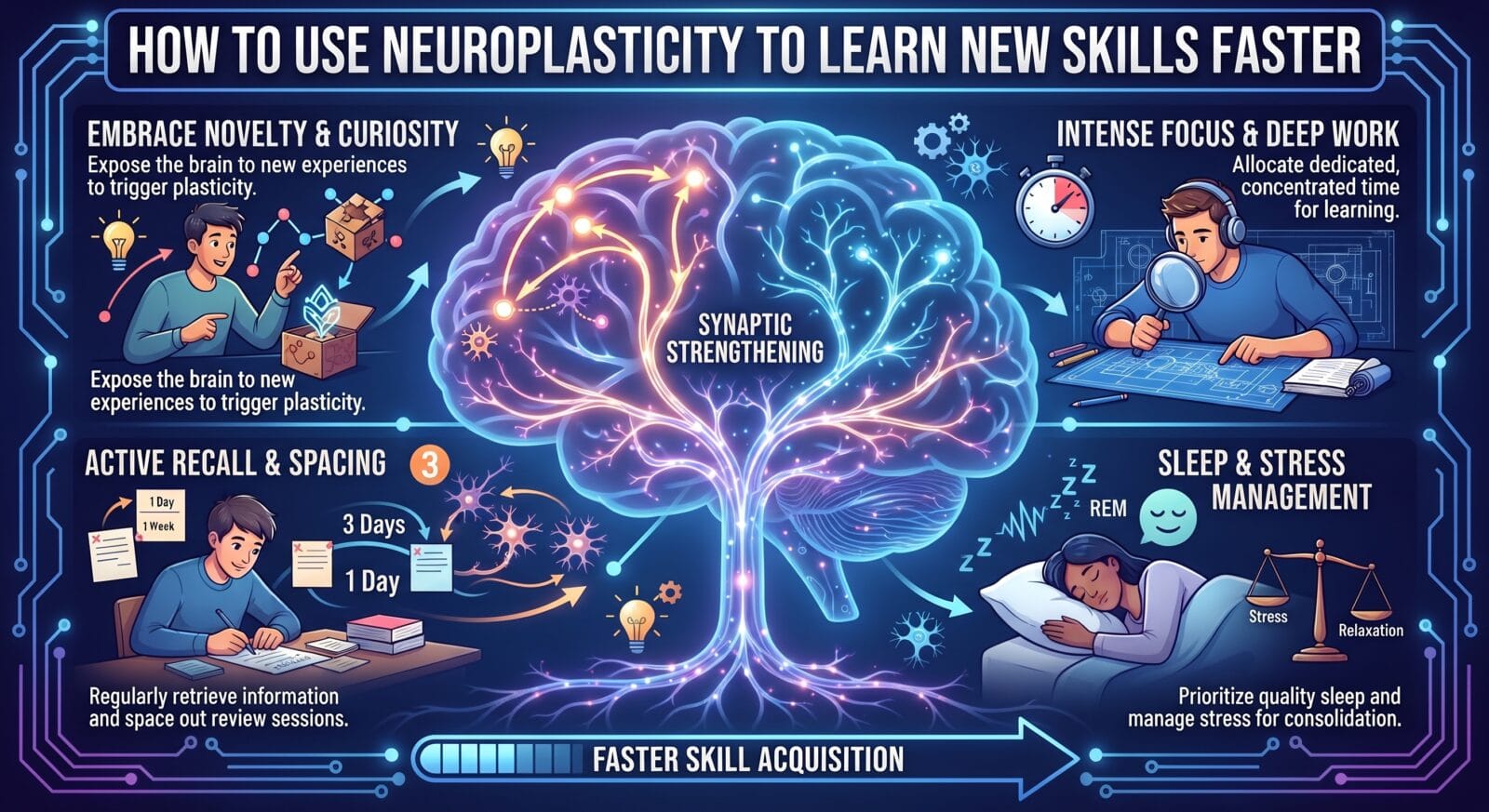

How to use neuroplasticity to learn new skills faster: A proven framework
The first step to mastering any new skill isn’t talent—it’s understanding how to use neuroplasticity to rewire your brain. Neuroplasticity, the brain’s incredible ability to reorganize itself by forming new neural connections, is the secret weapon behind accelerated learning. Whether you’re trying to learn a language, play an instrument, or code like a pro, your brain’s adaptability holds the key. This guide reveals the science-backed strategies to harness neuroplasticity and transform how you absorb and retain information.
Research from MIT shows that consistent, focused practice can reshape brain structures within weeks. The Harvard Medical School further confirms that deliberate repetition of specific actions strengthens neural pathways, making skills almost automatic over time. By applying these principles, you’re not just learning—you’re literally changing your brain’s architecture. The best part? Anyone can do this, regardless of age or prior experience. Ready to unlock your brain’s full potential? Let’s dive into the science and actionable steps. This section covers practical details about How to use neuroplasticity.
What Is Neuroplasticity and Why It Matters for Learning
How to use neuroplasticity starts with grasping what it actually is. Neuroplasticity refers to the brain’s lifelong ability to adapt and reorganize itself in response to learning, experience, or injury. Unlike the rigid wiring we once believed, your brain is constantly remodeling—forming new synapses, pruning unused ones, and adjusting its connections based on what you focus on. This adaptability is why a child can learn a language effortlessly while adults struggle, yet why adults can leverage strategic methods to outpace innate talent.
Why does this matter for skill acquisition? Because every time you practice a skill, your brain strengthens the neural circuits involved. Studies using fMRI scans reveal that taxi drivers in London develop larger hippocampi (memory centers) after memorizing the city’s complex streets. Similarly, musicians show enhanced auditory cortex activity. The takeaway? Skills aren’t just stored in your brain—they physically reshape it. The faster you understand and apply neuroplasticity principles, the sooner you’ll see measurable progress in your learning journey. In depth, How to use neuroplasticity stands out as a core theme.

The myth that adults can’t change their brains is long debunked. A 2018 study in Nature Neuroscience demonstrated that even seniors can grow new neurons through aerobic exercise and cognitive challenges. This proves neuroplasticity isn’t limited to childhood—it’s a 24/7 opportunity. The next time you hear someone say “I’m just not good at this,” remind them: with the right approach, their brain can adapt. Applying How to use neuroplasticity knowledge helps in real situations.
Neural Pathways: Building the Brain’s Superhighways
Think of neural pathways as highways in your brain. The more traffic (repetition) a route gets, the wider and faster it becomes. For example, when learning to drive, your initial actions feel clumsy because the pathway between your hands, eyes, and brain is narrow. With practice, this route becomes a six-lane expressway—effortless and automatic. How to use neuroplasticity effectively means intentionally directing this traffic.
How do you build these superhighways? Focus and repetition. A study from the University of California found that 10 minutes of daily practice over a month strengthened neural connections as effectively as longer, sporadic sessions. This aligns with the concept of “micro-learning,” where small, consistent efforts compound over time. The key is specificity: practicing scales on a guitar won’t help you master Spanish conjugations. Target your practice to the exact skill you want to develop. In summary, you can take informed steps on How to use neuroplasticity.
Visualization is another powerful tool. Athletes like Michael Phelps use mental rehearsal to activate the same neural pathways as physical practice. By vividly imagining each step of a skill, you prime your brain’s circuits for real-world execution. Combine visualization with physical practice, and you double the neuroplasticity benefits. Overall, How to use neuroplasticity is valuable for anyone exploring this topic.
Synaptic Plasticity: Strengthening Connections
At the microscopic level, neuroplasticity operates through synaptic plasticity—the ability of synapses (connections between neurons) to strengthen or weaken over time. This process, governed by Hebb’s Law (“neurons that fire together, wire together”), explains why habits form and skills stick. When you repeatedly activate certain neurons together, their link becomes permanent. How to use neuroplasticity to your advantage means creating these “fire-together” moments intentionally.
How can you leverage synaptic plasticity? One method is spaced repetition, popularized by the Leitner system. This technique spaces out review sessions at increasing intervals, forcing your brain to retrieve information just before it’s about to forget. Apps like Anki automate this process, but you can replicate it manually with a notebook and timer. The goal is to create challenges that spark your brain to “re-wire” for retention. Learning about How to use neuroplasticity makes a real difference.

Another key factor is novelty. Introducing new challenges forces your brain to forge uncharted pathways. Learning a musical instrument? Try playing a song in a different key. Studying a language? Practice writing with your non-dominant hand. These small shocks to your system stimulate synaptic growth. Interestingly, stress in moderation can also enhance plasticity—though chronic stress does the opposite. Balance challenge with recovery to maximize benefits. Research on How to use neuroplasticity reveals interesting findings.
How Neuroplasticity Works: The Science Behind Skill Acquisition
Understanding how to use neuroplasticity requires a deeper look at the mechanics. When you learn something new, your brain’s neurons communicate via electrical impulses. Initially, these signals are weak and circuitous. But with repetition, the myelin sheath (a fatty layer insulating neurons) thickens, speeding up transmission. This is why skills feel automatic after practice—the neural “wires” are now insulated for efficiency.
Another critical player is the prefrontal cortex, responsible for decision-making and focus. When you concentrate intensely on a task, this region lights up on brain scans, signaling neuroplastic changes. Conversely, distractions fragment your attention, weakening the desired pathways. This explains why multitasking hinders learning. To optimize plasticity, prioritize single-tasking and eliminate interruptions. Understanding How to use neuroplasticity is key to success in this area.
Dopamine, the brain’s reward chemical, also plays a starring role. Every time you succeed at a new skill, dopamine surges, reinforcing the neural pathway. This is why gamification works—points, badges, and progress bars trigger dopamine hits, accelerating plasticity. Apps like Duolingo use this principle to keep users engaged. For skill mastery, structure your practice to include frequent small wins. This section covers practical details about How to use neuroplasticity.
Statistical Data: How to use neuroplasticity to learn new skills fas
Neural Adaptation: Why Practice Makes Perfect
Neural adaptation is the brain’s way of optimizing performance. When you repeat a task, your brain streamlines the process by eliminating unnecessary steps. A classic example is touch-typing: beginners hunt-and-peck, but experts type without looking because their brain has automated the movements. How to use neuroplasticity to achieve this involves two phases: acquisition and automation.
During acquisition, your brain builds temporary pathways. These are fragile—like sandcastles at the shore—easily washed away without reinforcement. The automation phase begins once myelin forms and pathways stabilize. To reach automation faster, use the “20% effort” rule: practice until the skill feels 80% comfortable, then switch to maintenance mode. Over-practicing early on can lead to burnout without proportional gains. In depth, How to use neuroplasticity stands out as a core theme.
Interestingly, sleep is critical for neural adaptation. During REM sleep, your brain replays the day’s activities, strengthening newly formed connections. A Stanford study found that students who slept after learning performed 30% better on tests. Prioritize sleep to lock in your hard-earned progress. Applying How to use neuroplasticity knowledge helps in real situations.
Age Factors: Neuroplasticity Across the Lifespan
While neuroplasticity is strongest in childhood, it persists throughout life—just at different intensities. Children’s brains are like sponges, absorbing new skills effortlessly due to high synaptic density. Adults, however, have more refined neural networks but also more established habits (good or bad). How to use neuroplasticity effectively as an adult means working with, not against, these existing structures.
For older learners, the key is to focus on novelty and challenge. A 2020 study in Psychological Science showed that adults over 60 who learned digital photography or quilting for the first time improved memory function by 25%. The takeaway? It’s never too late to rewire your brain—just choose activities that push your limits without overwhelming you. In summary, you can take informed steps on How to use neuroplasticity.
Another age-related factor is motivation. Children learn through curiosity, but adults often need external incentives. Gamification, social accountability, and visible progress charts can bridge this gap. The brain responds to rewards, so structure your learning environment to include them. Overall, How to use neuroplasticity is valuable for anyone exploring this topic.
5 Practical Steps to Use Neuroplasticity for Faster Learning
Ready to put how to use neuroplasticity into action? Start with these five science-backed strategies. Each step targets a different aspect of brain plasticity, from neural growth to memory retention. Implement them one at a time, and you’ll notice skills clicking into place faster than ever before.
First, identify the skill you want to master. Be specific—“learn Spanish” is too vague. Instead, aim for “conjugate regular -ar verbs in the present tense.” Specificity directs your brain’s plasticity where it’s needed most. Write down your goal and break it into micro-tasks (e.g., “practice 10 verbs today”). This clarity reduces the cognitive load during practice. Learning about How to use neuroplasticity makes a real difference.
Next, gather the right tools. Quality resources accelerate learning by reducing friction. For language learning, apps like Memrise use spaced repetition and gamification. For coding, platforms like Codecademy provide interactive exercises. The fewer barriers between you and practice, the smoother your neuroplasticity journey will be. Research on How to use neuroplasticity reveals interesting findings.
Finally, track your progress. Use a journal or app to log daily practice and milestones. Visible progress triggers dopamine, reinforcing your neural pathways. Apps like Notion or Google Sheets work well for this. Celebrate small wins—they’re the fuel for long-term plasticity. Understanding How to use neuroplasticity is key to success in this area.
The Power of Consistent Practice (Even 10 Minutes a Day)
Consistency is the cornerstone of neuroplasticity. A 2019 study in Nature Human Behaviour found that 10 minutes of daily practice over three months produced stronger neural adaptations than sporadic 2-hour sessions. Why? Because daily practice keeps the pathways “warm,” preventing decay. How to use neuroplasticity successfully hinges on this principle.
How do you maintain consistency? Start small. Commit to 10 minutes a day, then gradually increase. Use the “two-day rule”: never skip practice two days in a row. This prevents the momentum-killing guilt of missed sessions. Tools like habit trackers (e.g., Habitica) can help you stay accountable. This section covers practical details about How to use neuroplasticity.
Timing matters too. Practice during your peak energy hours—morning for most people, evening for night owls. Align your sessions with your natural rhythms to maximize focus. Avoid practicing when fatigued; plasticity thrives on alertness. In depth, How to use neuroplasticity stands out as a core theme.
Multisensory Learning: Engage All Your Senses
Your brain learns faster when multiple senses are engaged. This is why how to use neuroplasticity effectively involves multisensory techniques. For example, learning a language? Speak aloud, write by hand, and associate words with images. Each sense reinforces the others, creating stronger neural connections.
- Visual: Use flashcards with images, mind maps, or color-coded notes.
- Auditory: Listen to podcasts, repeat phrases aloud, or use text-to-speech tools.
- Kinesthetic: Act out actions (e.g., for vocabulary like “run”), use hand gestures, or practice physically.
- Tactile: Write on paper, use manipulatives (e.g., letter tiles for spelling), or trace shapes.
Multisensory learning is especially powerful for complex skills. A study from the University of California found that medical students who used tactile models (e.g., 3D-printed organs) retained anatomy information 50% better than those who relied solely on textbooks. The more senses you involve, the richer the neural tapestry becomes.
To apply this in daily life, design your practice sessions to include at least two senses. For coding, type out examples while saying them aloud. For music, play scales while tapping the rhythm with your foot. The goal is to create a sensory symphony that your brain can’t ignore.
The Role of Sleep in Memory Consolidation
Sleep is the unsung hero of neuroplasticity. During deep sleep, your brain replays the day’s learning, strengthening neural connections and pruning weak ones. A Harvard study showed that students who slept after learning performed significantly better on tests than those who stayed awake. How to use neuroplasticity without prioritizing sleep is like trying to build a house without a foundation.
How much sleep do you need? Aim for 7–9 hours, but quality matters more than quantity. Deep sleep (stages 3–4) is critical for memory consolidation. To improve sleep hygiene:
- Stick to a consistent sleep schedule.
- Avoid screens 1 hour before bed (blue light disrupts melatonin).
- Keep your bedroom cool and dark.
- Try relaxation techniques like meditation or deep breathing.
Naps can also boost plasticity. A 20-minute power nap after learning has been shown to enhance retention by 20%. Schedule naps strategically, especially after intense practice sessions. Your brain does its best work when you’re resting.
Daily Routines to Rewire Your Brain for Skill Mastery
Consistency breeds neuroplasticity. By embedding how to use neuroplasticity into your daily routine, you create an environment where your brain adapts effortlessly. Below is a sample routine designed to maximize plasticity for any skill. Adjust the timing and activities to fit your schedule.
Start your day with a 5-minute mindfulness session. Focus on your breath and set an intention for your practice (e.g., “Today, I will master the past tense in Spanish”). Mindfulness primes your prefrontal cortex for focused learning. Studies show it enhances neuroplasticity by reducing stress and improving attention.
Next, dedicate 15–20 minutes to deliberate practice. Choose a micro-task related to your skill (e.g., writing 5 sentences, solving 3 math problems, or playing a scale on an instrument). Use the Pomodoro technique (25 minutes of focus, 5-minute break) to maintain intensity. During breaks, move around—physical activity boosts blood flow to the brain, enhancing plasticity.
After practice, spend 10 minutes reviewing what you learned. Spaced repetition is key here. Use a tool like Anki or a simple flashcard system to revisit material at increasing intervals. This reinforces the neural pathways you just strengthened. End your day with a gratitude journal—reflecting on your progress triggers dopamine, further solidifying your efforts.
On weekends, challenge yourself with a “skill sprint”: a 1-hour deep dive into your practice. Combine all senses and push your limits slightly beyond your comfort zone. The novelty and intensity will accelerate plasticity. For example, if you’re learning guitar, try playing a song you’ve never heard before by ear.
3 Common Mistakes That Block Your Brain’s Plasticity
Even with the best intentions, many learners sabotage their neuroplasticity without realizing it. Here are three pitfalls to avoid when applying how to use neuroplasticity effectively.
Mistake #1: Relying on Passive Learning
Watching YouTube tutorials or passively reviewing notes feels productive, but it does little for neuroplasticity. Your brain needs active engagement to form new connections. Replace passive input with interactive practice. For example, instead of watching a cooking video, try the recipe yourself. The physical action is what rewires your brain.
Mistake #2: Ignoring Recovery Time
Neuroplasticity isn’t just about pushing harder—it’s about balancing effort with rest. Overtraining leads to mental fatigue, which weakens neural pathways. A 2021 study in Frontiers in Human Neuroscience found that learners who took breaks performed 40% better than those who powered through. Schedule downtime between sessions to let your brain consolidate learning.
Mistake #3: Chasing Perfection Over Progress
Perfectionism is the enemy of plasticity. When you fixate on flawless execution, you avoid the messy mistakes that fuel growth. Embrace the “ugly phase” of learning—those early struggles are where the magic happens. Research from the University of Texas shows that learners who accepted mistakes progressed 60% faster than those who sought perfection. Shift your mindset from “I must be perfect” to “I am building a skill.”
Best Tools and Resources to Enhance Neuroplasticity
To optimize how to use neuroplasticity, you need the right tools. Below is a curated list of resources designed to stimulate brain adaptation, from apps to books to physical tools. Pick 1–2 that align with your skill and integrate them into your routine.
For spaced repetition and gamification, Anki is the gold standard. Its algorithm adapts to your learning pace, reinforcing weak areas just before you forget them. Studies show it can increase retention by up to 80%. Pair it with pre-made decks for languages, medical terms, or coding concepts to jumpstart your practice.
For multisensory learning, Memrise combines spaced repetition with video clips of native speakers, making language acquisition more engaging. Their “Learn with Locals” feature ties words to real-life contexts, enhancing neural connections. For a budget-friendly alternative, try Duolingo, which uses gamification to keep you motivated.
Physical tools can also boost plasticity. The FingerWorks touch typing system uses tactile feedback to retrain muscle memory. For musicians, the Roland TR-8S drum machine provides hands-on practice with instant feedback. Even something as simple as a whiteboard for sketching ideas engages multiple senses.
| Tool/Resource | Best For | Neuroplasticity Benefit | Cost |
|---|---|---|---|
| Anki | Spaced repetition, memory retention | Strengthens weak neural pathways through targeted review | Free (mobile/desktop); $25/year for cloud sync |
| Memrise | Language learning, multisensory engagement | Combines visual, auditory, and kinesthetic learning | Free (basic); $8.99/month (pro) |
| Duolingo | Gamified learning, consistency | Triggers dopamine through rewards and streaks | Free; $6.99/month (super) |
| FingerWorks Touch Typing | Keyboard skills, muscle memory | Retrains motor cortex through tactile feedback | $129 (one-time) |
| Roland TR-8S | Music production, rhythm | Engages auditory and motor pathways simultaneously | $899 (price varies) |
For books, Soft-Wired: How the New Science of Brain Plasticity Can Change Your Life by Dr. Michael Merzenich is a must-read. Merzenich, a pioneer in neuroplasticity research, breaks down complex science into actionable steps. Another great pick is The Brain That Changes Itself by Norman Doidge, which features real-life stories of brain transformation.
Don’t overlook physical activity. Aerobic exercise like running, swimming, or cycling boosts BDNF (brain-derived neurotrophic factor), a protein that supports neuroplasticity. Aim for 30 minutes, 3–5 times a week. Even a brisk walk during breaks can enhance your brain’s adaptability.
Ready to transform your learning speed? Start by applying just one of these neuroplasticity techniques today—even a 10-minute session can spark measurable changes in your brain. For more advanced strategies, explore 🔰 Engaging Product Descriptions for Higher Sales to supercharge your skill development with expert insights.
Frequently Asked Questions About Using Neuroplasticity
📚 Related Articles:
How to use neuroplasticity to overcome a fear of public speaking?
Start with small, safe exposures—record yourself speaking, then gradually increase the audience size. Each session strengthens the neural pathways associated with confidence. Pair this with relaxation techniques (e.g., deep breathing) to rewire your brain’s stress response. Over time, the fear response diminishes as your brain adapts to the new normal.
What’s the fastest way to use neuroplasticity for language learning?
The fastest method combines spaced repetition (Anki), immersive practice (language apps), and daily conversation. Focus on high-frequency words and phrases, and use them in real contexts. Consistency is key—even 15 minutes daily will outperform cramming. The brain adapts to patterns, so prioritize input that mimics natural speech.
Looking for more step-by-step tutorials? See the Practical How-To Guides hub.
Related guides: How to choose the right productivity app for your workflow · The evolution of remote work: Trends for 2027 and beyond