


On a sunny day, when you look up at the sky, there is a question that puzzles both children and scientists alike: Why is the sky blue? While the answer may seem simple, it actually takes us on a deep journey involving physics, light, and our atmosphere. In this guide, we will explain this mystery in a clear and engaging way, starting from basic knowledge to more advanced concepts.

1️⃣ Why Is the Sky Blue?
On a clear sunny day, when you look up, you’ll notice the sky is blue. But why is the sky blue and not, say, green or purple? This question has fascinated both scientists and curious minds for centuries.
This natural scattering of blue light explains why is the sky blue on a clear sunny day.
The answer lies in how sunlight interacts with Earth’s atmosphere. Sunlight may look white, but it actually contains all colors of the visible spectrum — just like a rainbow.
As this light passes through the atmosphere, the shorter wavelengths like blue and violet scatter more than longer ones like red. This process is called Rayleigh scattering.
Even though violet scatters more than blue, our eyes are more sensitive to blue light, and the sun emits more blue wavelengths. This is why we see the sky as blue.
So, the next time someone asks why the sky is blue, you’ll know: it’s a beautiful result of light physics and how our atmosphere plays with sunlight..

2️⃣ What Is Light Made Of?
Light is made of electromagnetic waves, and each wave has a different wavelength. These wavelengths determine the color of the light. Red has the longest wavelength, and violet has the shortest.
When light travels from the Sun to Earth, it moves in straight lines unless something gets in its way — like the molecules in our atmosphere. That’s when scattering happens. Shorter wavelengths, like blue and violet, get bounced around in all directions when they hit these molecules. That’s why those colors are more visible in the sky.
Understanding the components of visible light helps us uncover why is the sky blue in the daytime
Our eyes are designed to see certain wavelengths better than others. Blue happens to be right in our visible comfort zone, while violet is less easily detected.
So, understanding what light is made of helps us unlock many optical wonders — from blue skies to rainbows and even camera lenses.
3️⃣ Sunlight: White but Full of Color – why is the sky blue
Sunlight may appear white to our eyes, but it’s actually made up of all visible colors combined. You can see this when light passes through a prism and breaks into a rainbow.
This natural light contains red, orange, yellow, green, blue, indigo, and violet. When sunlight hits the atmosphere, each color reacts differently based on its wavelength.
Blue and violet wavelengths scatter more, while red and orange pass through more directly. That’s why the colors in sunlight don’t reach our eyes equally.
During the day, we mainly receive scattered blue light from all directions, making the entire sky look blue. This only changes when the sun is low on the horizon.
So, even though the Sun gives off all colors, it’s the way Earth’s atmosphere filters and bends those sunlight colors that paints our skies.
By examining how white light breaks into colors, we understand why is the sky blue to our eyes
4️⃣ The Role of the Atmosphere – why is the sky blue
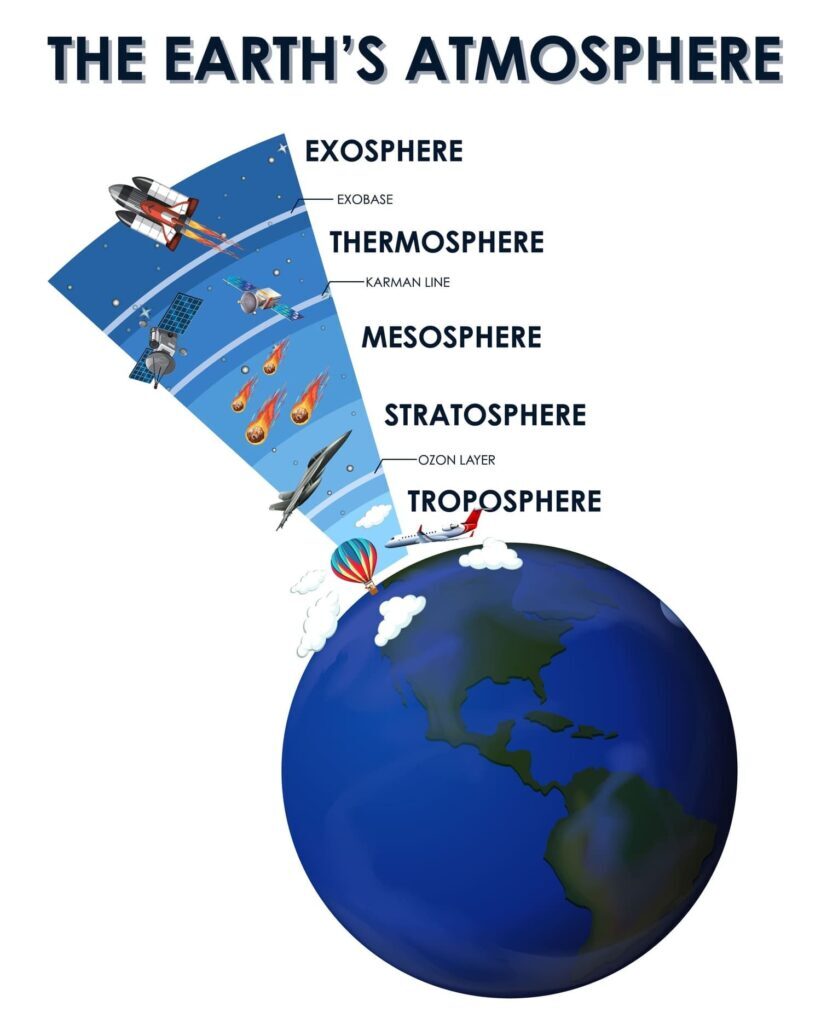
The Earth’s atmosphere plays a crucial role in determining the color of the sky. It’s made up of gases like nitrogen, oxygen, and trace amounts of other particles that affect how sunlight travels.
When sunlight enters our atmosphere, it doesn’t pass straight through — it collides with gas molecules. These collisions cause the light to scatter, especially the shorter wavelengths like blue and violet.
The density and composition of the atmosphere also affect how much light gets scattered. On a planet with no atmosphere, like the Moon, the sky appears completely black.
Our atmosphere not only scatters light but also absorbs some of it. For example, ultraviolet rays are mostly blocked by the ozone layer, protecting us from harmful radiation.
The composition and thickness of our atmosphere play a critical role in answering why is the sky blue.
So without the Earth’s atmosphere, the sky wouldn’t appear blue at all. It’s the invisible layers of air above us that create the blue canopy we see each day.
Earth’s atmosphere plays a crucial role in why is the sky blue — without it, sunlight wouldn’t scatter and the sky would appear colorless like space
5️⃣ Rayleigh Scattering Explained Simply – why is the sky blue
Rayleigh scattering is the scientific name for the phenomenon that makes the sky blue. It describes how light is scattered when it hits particles much smaller than its wavelength — like air molecules.
This effect is strongest for shorter wavelengths, which means that blue light (shorter than red) gets scattered more. That’s why we see blue more often in the sky than other colors.
Lord Rayleigh discovered this principle in the 1800s while studying gases and light. His work explained why the sky isn’t colorless despite light traveling in straight lines.
Importantly, Rayleigh scattering also explains why sunsets appear red or orange. At that time of day, sunlight travels through more atmosphere, scattering the blue light away from our view.
In simple terms: Rayleigh scattering is nature’s way of bending light, and it’s responsible for many colorful effects we see every day.
Rayleigh scattering is at the heart of why is the sky blue — it explains how shorter light wavelengths scatter more efficiently
Rayleigh scattering is the main scientific reason behind why is the sky blue and not violet.

6️⃣ Why Not Purple or Red?
If violet light scatters more than blue, you might wonder — why isn’t the sky purple? The answer lies in a mix of biology and solar physics.
First, the Sun emits less violet light than blue, so there’s simply less violet to scatter in the first place. Second, our eyes are not very sensitive to violet wavelengths.
Also, some of the violet light that does reach Earth is absorbed by the ozone layer. This further reduces the amount of purple light that actually reaches our eyes.
Instead, blue wins the visual competition. Our eyes have three types of cones that are tuned to detect red, green, and blue. The blue cones respond strongly to the scattered light.
So while purple light is indeed being scattered, it’s our biology that filters it out — making blue the most dominant color in the sky.
Our perception and light sensitivity clarify why is the sky blue instead of purple during the day.
7️⃣ Why Is the Sky Red During Sunrise and Sunset?
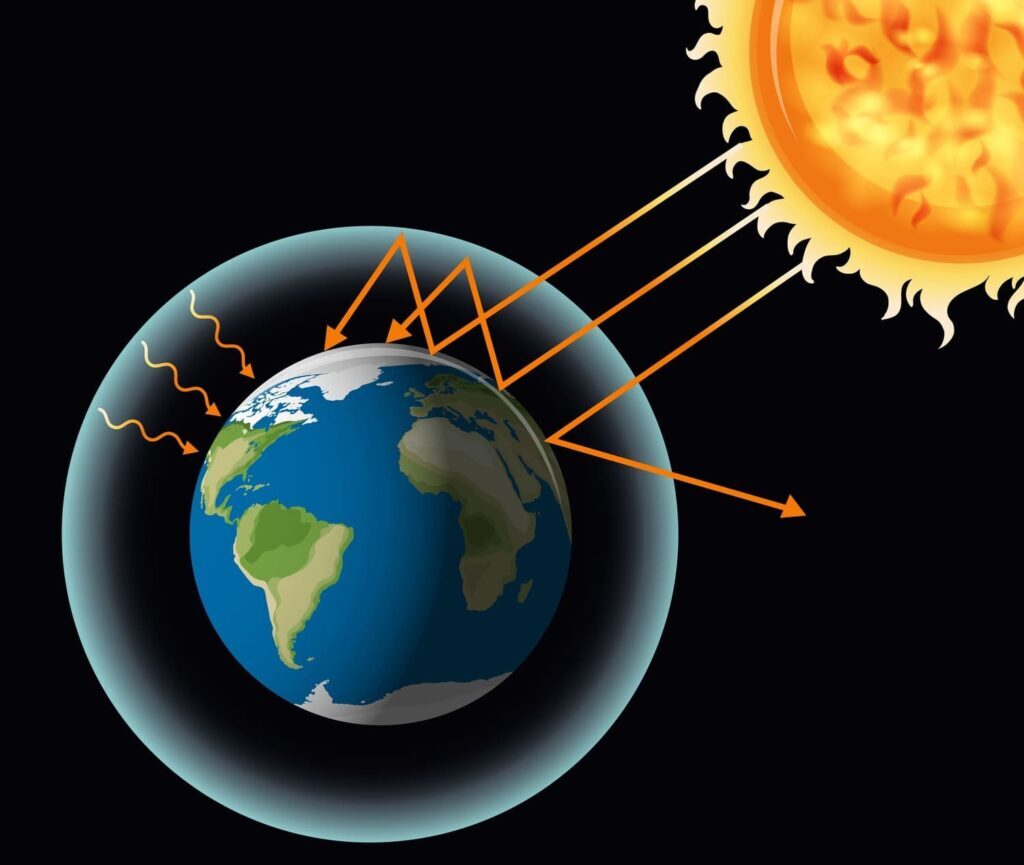
During sunrise and sunset, the Sun sits lower on the horizon. This means its light has to travel a much longer distance through Earth’s atmosphere before reaching your eyes.
As the sunlight passes through more air, molecules and particles scatter the shorter wavelengths — like blue and violet — out of your direct line of sight.
What’s left are the longer wavelengths: red, orange, and yellow. These warm hues travel more directly and become more visible during sunrise and sunset, giving the sky its iconic reddish glow.
Dust, pollution, and water vapor can also enhance this effect. That’s why urban areas or dry climates often see even more intense red skies at sunset compared to clean, humid places.
So, the red sky at sunset is not just beautiful — it’s also a visual demonstration of atmospheric physics in action, influenced by distance, air particles, and your viewing angle.
The shifting of light wavelengths at sunset helps contrast and emphasize why is the sky blue at noon.

8️⃣ Why Is the Sky Sometimes Gray?
A gray sky usually occurs when thick clouds form and block direct sunlight. These clouds are made up of tiny water droplets or ice crystals that scatter light differently than air molecules do.
Unlike Rayleigh scattering — which affects specific wavelengths — cloud particles are much larger. They scatter all visible wavelengths more equally, resulting in a dull, white or gray sky.
The thickness and density of the clouds determine how dark the gray becomes. Light clouds may appear light gray, while heavy storm clouds can turn the sky a deep charcoal tone.
Interestingly, the gray sky meaning often signals a weather change. It may suggest incoming rain, snow, or simply a lack of sun for the day — but it doesn’t always mean something bad.
So, when you see a gray sky, it’s not about light scattering in the usual way. It’s more about cloud layers reflecting and absorbing sunlight, which tones down the vibrancy of the sky’s color.
Cloud coverage and water droplets temporarily override the effect that explains why is the sky blue.

9️⃣ What Color Is the Sky on Other Planets?
Not all planets have blue skies like Earth. In fact, the sky color on other planets can vary drastically depending on their atmospheres — or lack thereof.
For example, Mars has a thin atmosphere filled with dust. The Martian sky often appears butterscotch or reddish during the day and bluish at sunset — the opposite of Earth!
Venus, with its dense and toxic atmosphere, has a yellowish sky caused by clouds of sulfuric acid. Meanwhile, planets like Mercury have almost no atmosphere, so their skies are pitch black even in daylight.
On giant gas planets like Jupiter or Saturn, the skies are multicolored due to different chemical compositions, including ammonia and methane. These create streaks of white, brown, and orange.
Studying the sky color on other planets helps scientists understand atmospheric composition and weather patterns beyond Earth. It’s not just a color — it’s a clue to planetary science.
Different atmospheres offer clues to why is the sky blue on Earth but not on Mars or Venus.

🔟 How to Explain This to Kids?
When explaining why the sky is blue to children, simplicity is key. Use relatable analogies and everyday examples to keep them engaged and curious.
You could say: “The sky is blue because sunlight hits tiny air bits, and blue light is the best at bouncing around — like a pinball!” This creates a vivid mental image.
Another great approach is to show them a glass of water with a flashlight and milk to simulate light scattering. This DIY science trick makes the concept of Rayleigh scattering more tangible.
Children also respond well to visual aids like drawings of rainbows and skies on different planets. Using pictures to explain the blue sky to kids makes abstract science fun and accessible.
Most importantly, keep the tone light, ask them questions, and encourage them to look up at the sky and wonder — because that’s how every young scientist begins.
Breaking down the science simply can help children understand why is the sky blue in a fun way.

1️⃣1️⃣ Quick Scientific Summary – why is the sky blue
The blue sky is the result of sunlight interacting with our atmosphere, specifically through Rayleigh scattering, which causes shorter blue wavelengths to spread more.
Sunlight may appear white, but it’s actually a blend of all visible colors. When it hits molecules in the air, the blue light scatters in all directions, making the whole sky appear blue to our eyes.
During sunrise and sunset, the light travels a longer path, scattering the blue out and letting reds and oranges dominate. Clouds can turn the sky gray by diffusing all light wavelengths.
Different planets offer different sky colors depending on atmosphere type, composition, and particle sizes — making sky color a fascinating subject beyond Earth.
This blue sky science summary boils down to one idea: light + air + physics = our beautiful blue dome above.
Summarizing the physics behind light and air gives us a full answer to why is the sky blue. Scientists have studied for centuries to answer questions like why is the sky blue. If you’ve ever wondered why is the sky blue, the answer lies in light and molecules.

1️⃣2️⃣ Fun Facts About the Blue Sky – why is the sky blue
- The sky isn’t truly blue — it’s colorless! It’s the scattering of sunlight that paints it blue.
- Violet light scatters more than blue, but we don’t see it due to our eyes being less sensitive to violet.
- You can see a different sky color at high altitudes, like deep indigo from mountaintops or planes.
- Astronauts see a black sky even during daytime because there’s no atmosphere in space to scatter light.
- Pollution and dust can change sky color, making it more hazy or orange, especially in cities.
These fun facts about the sky show how much wonder is hidden in a seemingly simple daily sight. Next time you look up, you’ll see it with a smarter gaze!.
Even trivia and surprising facts can reinforce your grasp on why is the sky blue every day. From poems to paintings, people have always asked why is the sky blue. One fun fact is that astronauts don’t see blue skies in space, which reminds us why is the sky blue only on Earth.

🌤️ Curious about more sky science and nature facts?
✅ Discover step-by-step science explainers and sky-related guides at: QuickGuideHub.com
🛍️ Looking for educational posters or models?
✅ Visit our curated collection on eBay: Trendigoshop Store
❓ Frequently Asked Questions (FAQ)
Q1: Why is the sky blue during the day?
A1: Due to Rayleigh scattering, shorter blue wavelengths of sunlight are scattered more in the atmosphere, making the sky appear blue.
Q2: Why isn’t the sky violet if violet light scatters even more?
A2: Though violet light scatters more, our eyes are more sensitive to blue, and sunlight contains less violet. The result: a dominantly blue sky.
Q3: Why does the sky turn red during sunset?
A3: At sunrise or sunset, sunlight passes through more atmosphere, scattering short blue wavelengths and letting reds and oranges dominate.
Q4: Can weather conditions affect the sky’s color?
A4: Yes, humidity, pollution, and cloud density can mute or alter sky color, often resulting in gray or hazy tones instead of clear blue.
Q5: Is Rayleigh scattering the same on other planets?
A5: Not always. Other planets have different atmospheres; for example, Mars has a reddish sky due to its dust particles and thin air.

☀️ Understanding Light: A Beginner’s Guide
Take your first step into atmospheric science. Learn how sunlight and tiny molecules work together to paint the sky blue.
🌈 Rayleigh Scattering Explained Visually
Explore how different wavelengths of sunlight interact with the air. Clear diagrams and easy analogies help you truly get it.
🧪 More Fascinating Sky Phenomena
From red sunsets to grey clouds and Martian skies — discover what else the sky can teach us through physics and wonder.
