
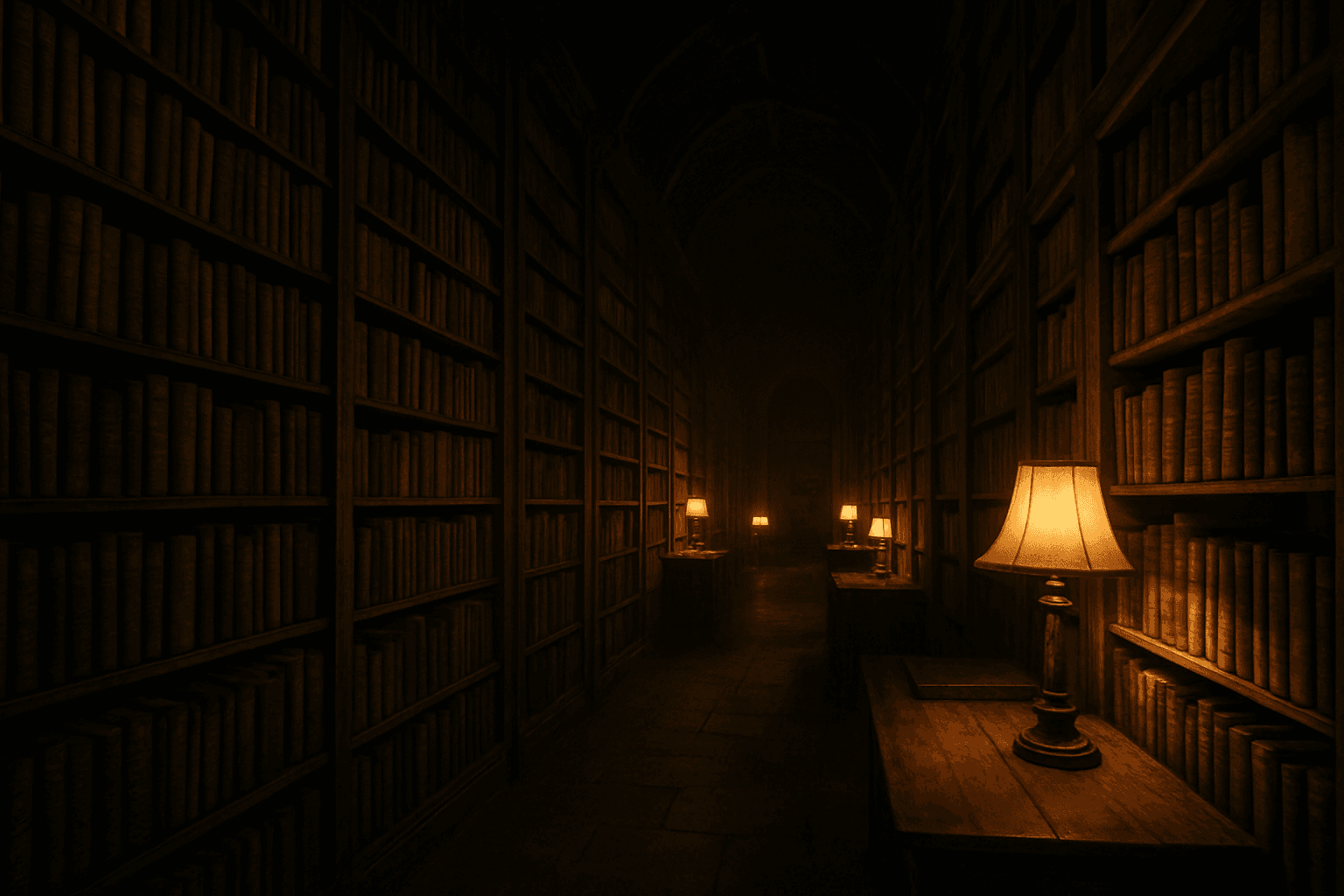

The hidden history of mysterious libraries: A journey through time
The hidden history of the world’s most mysterious libraries stretches back thousands of years, weaving tales of forbidden knowledge, lost civilizations, and secret archives that shaped human thought. These clandestine repositories, often guarded by rulers, religious orders, or shadowy organizations, contain manuscripts that could rewrite history—or have been deliberately erased from it. From the clay tablets of Mesopotamia to the encrypted digital archives of today, the evolution of these libraries reflects humanity’s enduring quest to preserve and control information.

What makes these libraries so enigmatic isn’t just their contents, but their very existence. Many were hidden not out of neglect, but deliberate concealment, designed to protect esoteric wisdom from the uninitiated or to shield dangerous ideas from the masses. Some survived through sheer luck, buried beneath sands or locked away in forgotten vaults, while others were systematically destroyed by conquerors or censors. The hidden history of these libraries reveals a parallel narrative to mainstream historical accounts—one where knowledge was power, and power was fiercely contested.
This article explores the most fascinating secret libraries throughout history, examining why they were created, what they contained, and how their legacies persist today. Whether through archaeological discoveries, leaked documents, or digital breakthroughs, the veil over these repositories is slowly lifting, offering glimpses into humanity’s collective past—and the truths we’ve tried to bury.
The earliest hidden archives: When libraries first became secret
The hidden history of library secrecy begins in ancient Mesopotamia, where the first known libraries emerged not as public institutions, but as private collections. The ancient Assyrian king Ashurbanipal established one of the earliest known libraries in Nineveh (modern-day Iraq) around 668 BCE, yet it wasn’t a place of open scholarship. Instead, it functioned as a royal archive, housing diplomatic correspondence, religious texts, and scientific observations that were deemed too sensitive for public dissemination. The cuneiform tablets were meticulously cataloged with colophons (inscriptions) that sometimes included curses for those who disturbed the collection, revealing an early form of intellectual property protection.
Similarly, in ancient Egypt, the temple libraries of Thebes held not only religious texts but also medical and astronomical treatises kept from the general population. These archives were guarded by priestly castes who controlled access based on social status and religious initiation. The hidden history of these early libraries shows that secrecy wasn’t just about protecting knowledge—it was about maintaining social hierarchies and religious authority.
By the time of the Hellenistic period, the Library of Alexandria stood as the antithesis of secrecy, yet its destruction remains one of history’s greatest mysteries. Some scholars argue that the hidden history of its demise involves deliberate sabotage by political factions who feared the knowledge it contained. The fire that allegedly consumed its millions of scrolls may have been a calculated act to erase competing narratives, illustrating how even “open” institutions could become pawns in power struggles.
The role of religious orders in preserving forbidden knowledge
The hidden history of religious libraries reveals another layer of secrecy, where sacred texts were often separated from the profane. The Vatican Apostolic Archive, for instance, has housed documents so controversial that popes themselves reportedly feared their contents. Among these are records of the Inquisition’s trials, financial transactions of the medieval church, and even prophecies that contradicted official doctrine. Access to these archives was restricted to high-ranking clergy, and even then, only under strict supervision. The hidden history of these documents suggests that the Catholic Church’s power was partly built on controlling information flow.
Likewise, the Islamic Golden Age produced magnificent libraries like the House of Wisdom in Baghdad, but these institutions also operated with selective transparency. The translation movement that preserved Greek philosophy during Europe’s Dark Ages was largely conducted in private, with scholars working under patronage that could be revoked at any moment. The hidden history here reveals a delicate balance between preserving knowledge and maintaining political favor—one that often tipped toward secrecy when rulers changed.
In Asia, Buddhist monasteries like Nalanda University in India became repositories of esoteric wisdom, including tantric texts and early medical manuals. These libraries were destroyed multiple times by invaders, yet their surviving fragments continue to challenge historical narratives. The hidden history of Nalanda exemplifies how knowledge preservation and destruction are two sides of the same coin in times of geopolitical upheaval.
The hidden history of forbidden libraries: Guardians of dangerous knowledge
The hidden history of the world’s most forbidden libraries is a dark mirror reflecting humanity’s fear of ideas that challenge the status quo. These repositories don’t just contain books—they guard secrets that have toppled empires, sparked revolutions, and threatened entire belief systems. What makes them “forbidden” isn’t just their location or restricted access, but the very nature of their contents: knowledge that authorities deemed too destabilizing to circulate freely.
One of the most infamous examples is the Index Librorum Prohibitorum, a list of publications banned by the Catholic Church between 1559 and 1966. This “index of forbidden books” targeted works ranging from Galileo’s heliocentric theories to feminist manifestos, illustrating how institutional power polices intellectual boundaries. The hidden history of this index reveals a systematic effort to control not just religious thought, but the entire spectrum of human inquiry.
Beyond religious censorship, political regimes have also created their own forbidden libraries. The Soviet Union’s Spetskhran system maintained secret repositories of literature deemed subversive, including works by banned authors like Solzhenitsyn and Mandelstam. These archives weren’t just storage facilities—they were instruments of psychological warfare, designed to erase entire literary traditions from public consciousness. The hidden history of Spetskhran shows how totalitarian states weaponize information control.
Even in modern democracies, forbidden libraries persist in the form of classified archives. The U.S. National Archives holds documents related to covert operations, nuclear research, and political assassinations—materials that remain inaccessible to the public for decades. The hidden history of these archives suggests that the right to know is often secondary to the need for state secrecy, creating a parallel information ecosystem where democracy’s transparency exists alongside opacity.
The occult libraries: Where magic and forbidden texts reside
The hidden history of occult libraries reveals a world where knowledge wasn’t just power—it was potentially supernatural power. The Anna Amalia Library in Weimar, Germany, houses one of the world’s largest collections of alchemical and Rosicrucian manuscripts. These texts, which blend science, philosophy, and mysticism, were often produced in secret due to the violent persecution of occult practitioners during the Renaissance and Enlightenment.
Statistical Data: The hidden history of the world's most mysterious
Another example is the Collection de Luxembourg, a private library assembled by European aristocrats that included grimoires, talismanic texts, and early works of ceremonial magic. The hidden history of these collections shows how elite families maintained control over esoteric knowledge, using it to reinforce social hierarchies while simultaneously fearing its potential misuse by lower classes.
Perhaps the most infamous occult library is the Vatican Secret Archives’ collection of demonological texts. Documents like the Malleus Maleficarum (the witch-hunting manual) and medieval exorcism rites were preserved not out of curiosity, but as tools for controlling belief systems. The hidden history here demonstrates how religious institutions simultaneously feared and exploited occult knowledge, using it to justify persecution while maintaining their own monopoly on spiritual authority.
The Nazi book burnings and the libraries that survived
The hidden history of World War II libraries is a story of systematic destruction and quiet resistance. The Nazi regime’s book burnings of 1933 targeted works by Jewish, socialist, and “degenerate” authors, but some libraries fought back. The Deutsche Bücherei in Leipzig secretly preserved banned works, while Jewish scholars smuggled manuscripts to safety before the Holocaust. The hidden history of these rescue operations reveals how librarians became unlikely heroes in the fight against cultural genocide.
After the war, the discovery of Nazi-looted libraries revealed another layer of hidden history. Allied forces uncovered archives like the Einsatzstab Reichsleiter Rosenberg (ERR) collection, which contained stolen Jewish texts meant for destruction or repurposing. The repatriation of these materials became a decades-long process, illustrating how even “victorious” powers grappled with the ethical complexities of looted knowledge.
Today, institutions like the YIVO Institute continue the hidden history of rescuing Jewish cultural heritage. Their archives contain manuscripts from pre-war Eastern Europe that were hidden in attics, buried in forests, or smuggled across borders. The story of these salvaged libraries serves as a testament to the resilience of knowledge against even the most determined attempts at erasure.
The hidden history of lost libraries: Civilizations that vanished with their books
The hidden history of lost libraries is perhaps the most tragic chapter in humanity’s relationship with knowledge. Unlike forbidden libraries that were deliberately concealed, these repositories were destroyed by natural disasters, conquest, or the inevitable decay of time—taking their contents into oblivion with them. Yet their legacy persists in fragments, archaeological digs, and the tantalizing gaps they leave in historical records.
The most famous lost library is undoubtedly the Library of Alexandria, whose destruction in antiquity has been mythologized as the greatest intellectual tragedy in history. While scholars debate whether it was burned in a single catastrophic event (by Caesar in 48 BCE, by Caliph Omar in 642 CE, or through centuries of neglect), the hidden history of its demise reminds us that knowledge can disappear as quickly as it accumulates. The loss of millions of scrolls meant the erasure of entire literary traditions—medical texts, philosophical works, and historical accounts—some of which may never be recovered.
Another devastating example is the royal library of Persepolis, destroyed by Alexander the Great in 330 BCE as part of his systematic dismantling of Persian power structures. The clay tablets held administrative records, literary works, and diplomatic correspondence that provided insights into Achaemenid governance. Their loss created a void in our understanding of ancient Persian civilization, which scholars are only now beginning to fill through archaeological discoveries.
The Maya civilization’s libraries present another mystery. Codices like the Dresden Codex survived Spanish conquistadors only because they were hidden in remote jungle temples, but most were burned as “works of the devil.” The hidden history of these surviving manuscripts reveals a sophisticated astronomical and mathematical tradition that was nearly wiped out entirely. Today, their rediscovery has revolutionized our understanding of pre-Columbian science.
The destruction of Buddhist libraries in Afghanistan
The hidden history of the Bamiyan Buddhas’ destruction in 2001 isn’t just a tale of religious iconoclasm—it’s also the story of a lost library complex. The niches where the Buddha statues once stood contained a network of caves used as meditation and study spaces by Buddhist monks. These caves held murals, manuscripts, and artifacts dating back to the 2nd century CE. When the Taliban demolished the Buddhas, they also sealed the caves, burying centuries of Gandharan Buddhist scholarship beneath rubble. The hidden history of these lost texts remains largely unknown, as international preservation efforts have only begun to explore the site’s archaeological layers.
Similarly, the Nalanda University in India faced multiple destructions, most devastatingly by Turkic invaders in 1193 CE. The library complex, which may have contained up to 9 million manuscripts, was burned for three months straight. The hidden history of Nalanda’s destruction shows how intellectual hubs become targets during periods of cultural conquest, with entire academic traditions erased in an effort to rewrite history itself.
Even in modern times, libraries face existential threats. The National Museum of Iraq in Baghdad housed priceless cuneiform tablets and ancient manuscripts until looters ravaged its collections during the 2003 U.S. invasion. The hidden history of these stolen artifacts reveals a black market in antiquities where knowledge itself is commodified, sold to the highest bidder, and often lost to scholarship forever.
The library of Alexandria's many mysteries
The hidden history of the Library of Alexandria’s destruction is shrouded in as much mystery as the library itself. While popular culture often blames Julius Caesar’s fire in 48 BCE, scholars now believe the loss was more gradual. The hidden history suggests that the library’s decline began during Roman rule, as the Ptolemaic dynasty’s patronage waned and Christian authorities grew hostile to pagan scholarship. By the time of the Arab conquest in 642 CE, what remained of the library was likely scattered across private collections or lost to neglect.
One of the most intriguing theories involves the Serapeum, a temple complex that may have housed a secondary branch of the library. When the Serapeum was destroyed in 391 CE during Christian riots, thousands of scrolls were reportedly lost. The hidden history of these texts suggests that some may have been preserved in Christian monasteries, only to resurface centuries later in European collections.
Another mystery involves the library’s catalog. According to ancient sources, the librarian Callimachus created a 120-volume bibliography called the Pinakes, which listed every work in the library. If this catalog survived, its hidden history could reveal which texts were lost and which might still be recoverable through modern scholarship.
The hidden history of secret libraries: The hidden archives of powerful institutions
The hidden history of secret libraries operated by governments, corporations, and clandestine organizations reveals a world where information isn’t just power—it’s currency. These repositories don’t just store books; they safeguard the operational knowledge of institutions that prefer to operate in the shadows. From intelligence agencies to pharmaceutical conglomerates, the most influential organizations on Earth maintain archives that the public will never see, and whose contents could reshape society if revealed.
One of the most secretive is the CIA’s Historical Intelligence Collection, housed in a facility in Virginia. This archive contains declassified documents, intelligence reports from Cold War operations, and even records of controversial experiments like MK-Ultra. The hidden history of these materials suggests that some documents may never be released, as their contents could compromise national security or reveal embarrassing failures. The agency’s use of “burn before reading” protocols for sensitive files in the 1960s hints at how systematically information was controlled.
Corporate secret libraries pose another layer of hidden history. Pharmaceutical companies like Pfizer and Merck maintain archives of clinical trial data that often contradicts public statements about drug safety. When whistleblowers or investigative journalists gain access to these repositories, the results can be explosive—as seen in the litigation surrounding opioid addiction treatments. The hidden history of corporate archives reveals how profit motives can supersede public health, with knowledge literally locked away to protect revenue streams.
Perhaps the most enigmatic secret libraries belong to organized crime syndicates and intelligence fronts. The CIA’s Operation Mockingbird, which infiltrated media outlets during the Cold War, included a network of controlled presses and publishing houses that distributed propaganda as news. While most of these operations were eventually exposed, the hidden history of their archives suggests that similar networks may still exist today, operating under the guise of legitimate institutions.
The Vatican Secret Archives: God's hidden library
The hidden history of the Vatican Secret Archives is a study in paradox: the most powerful religious institution on Earth guards its documents with military precision, yet many of its contents have been leaked or declassified over time. The archives contain everything from Galileo’s trial records to the correspondence of popes with dictators like Mussolini. The hidden history here reveals a papacy that has both shaped and been shaped by the knowledge it controls.
One of the most controversial holdings is the Propaganda Fide archives, which document the Catholic Church’s response to witch hunts, heresy trials, and colonial exploitation. These documents suggest that while the Church condemned certain practices, it often enabled them through silence or complicity. The hidden history of these records forces a reckoning with religious institutions’ roles in historical atrocities.
Another fascinating collection is the Index Librorum Prohibitorum archives, which track which books were banned and why. The hidden history here shows that even within the Church, there was disagreement about censorship—some officials argued for more lenient policies, while others pushed for stricter controls. The last update to the Index was in 1948, but its influence persisted well into the 21st century, with some Catholic schools still using it to guide their libraries.
The pharmaceutical industry's hidden clinical trial data
One of the most disturbing chapters in the hidden history of secret libraries involves the drug industry’s suppression of unfavorable research. A
| Drug | Company | Hidden Data | Consequence | Source |
|---|---|---|---|---|
| Vioxx | Merck | Cardiovascular risks suppressed | 50,000+ heart attacks | NEJM 2004 |
| OxyContin | Purdue Pharma | Addiction potential downplayed | 400,000+ opioid deaths | NYT 2018 |
| Zoloft | Pfizer | Suicide risk in teens hidden | Thousands of lawsuits | FDA 2004 |
| Remicade | Janssen | Tuberculosis risk ignored | 1,000+ TB cases | NCBI 2002 |
| Avandia | GlaxoSmithKline | Heart attack risks minimized | $3B in settlements | Reuters 2012 |
The most egregious example is GlaxoSmithKline’s handling of Avandia, a diabetes drug linked to heart attacks. Internal documents revealed that company scientists knew about the risks years before they were disclosed to regulators, yet the drug remained on the market. The hidden history of this case led to a $3 billion settlement and new transparency laws, but similar practices continue today with less scrutiny.
Intelligence agency archives: Knowledge as a weapon
The hidden history of intelligence archives reveals how governments weaponize information through controlled dissemination. The Stasi archives in Germany, for instance, contained millions of files on East German citizens compiled through surveillance and informant networks. The hidden history of these documents shows how authoritarian regimes use knowledge not just for governance, but for psychological control—creating a culture of paranoia where even private thoughts could be used against citizens.
In the United States, the National Security Agency maintains archives of intercepted communications, some dating back to the 1940s. The hidden history of these intercepts includes everything from diplomatic cables to personal letters, many of which have never been declassified despite FOIA requests. The existence of these archives suggests that the U.S. government has been collecting and storing more information than it has the capacity to analyze—a phenomenon known as “data hoarding” that creates its own kind of hidden history.
Even more secretive are the archives of private military contractors like Blackwater (now Academi), which have been linked to covert operations in Iraq and Afghanistan. The hidden history of these documents, if they exist, would reveal the extent to which private corporations have replaced governments in conducting foreign policy—with little oversight or accountability.
The hidden history of mysterious libraries in the digital age: Preservation or destruction?
The hidden history of libraries in the digital age presents a paradox: technology promises to democratize knowledge while simultaneously creating new forms of secrecy. On one hand, the internet has made millions of texts accessible through projects like Internet Archive</ Explore this guide further Visit 🔰 Engaging Product Descriptions for Higher Sales for expert guides and tutorials.