

The history of the Silk Road: Ancient Origins and Early Development
The history of the Silk Road begins more than 2,000 years ago when ancient Chinese rulers sought to establish secure trade connections beyond their borders. Emperor Wu of Han China, ruling from 141 to 87 BCE, officially opened diplomatic and commercial relations with Central Asia through a strategic initiative that would become foundational to global commerce. This network of trade routes wasn’t named “Silk Road” until 1877, when German geographer Ferdinand von Richthofen coined the term, but its roots stretch back to even earlier caravan trails used by pastoral nomads moving between China and the Eurasian steppes.
The name itself reflects the importance of Chinese silk, which became one of the most coveted commodities in ancient world markets. However, the road carried far more than silk—spices from India, glassware from Rome, and paper-making techniques from China traveled these routes long before they reached their final destinations. The history of the Silk Road demonstrates how economic necessity and cultural curiosity drove one of humanity’s most transformative connectivity projects.
Archaeological evidence reveals that these trade networks emerged organically as early as the 2nd millennium BCE. Bronze Age cultures in present-day Kazakhstan and Kyrgyzstan facilitated exchanges between settled agricultural societies in China and pastoral communities across the steppe. These early interactions laid the groundwork for what would become a sophisticated system of relay trade, where goods changed hands multiple times between their origin and final consumer.
China’s Strategic Vision and Diplomatic Missions
The history of the Silk Road’s formal establishment traces directly to China’s diplomatic overtures under Emperor Wu. The famous journey of Zhang Qian, a Han Dynasty envoy, between 138 and 126 BCE marked a turning point in these efforts. Zhang Qian’s missions to the Western Regions established direct contacts with Central Asian kingdoms, including Dayuan and Yuezhi, and secured alliances that would protect Chinese merchants traveling westward.

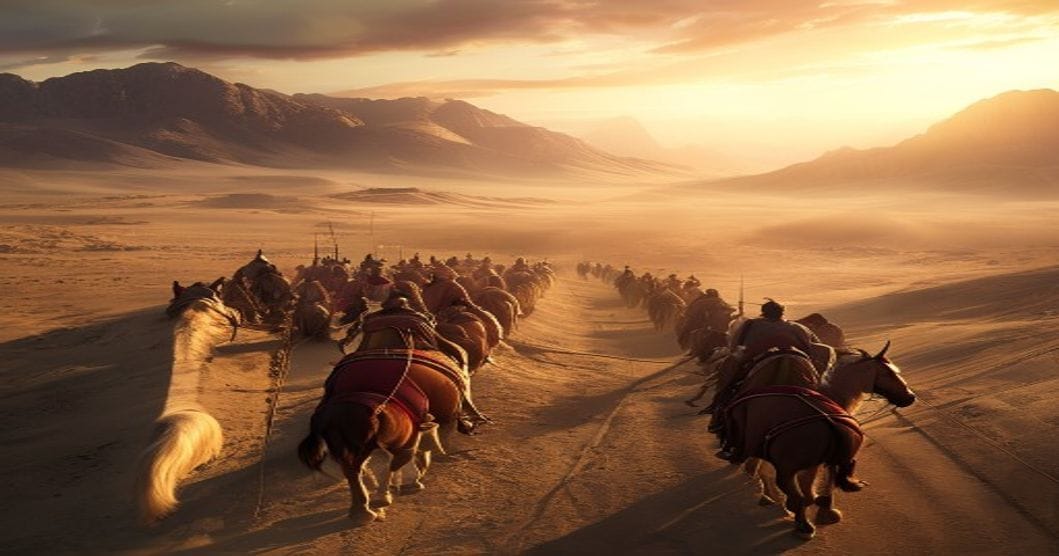
These diplomatic successes created the political stability necessary for large-scale commerce. Chinese records from this period describe caravans of up to 100 camels carrying silk, jade, and other luxury goods across treacherous deserts and mountain passes. The history of the Silk Road shows how military protection and diplomatic skill combined to create an economic superhighway that connected the world’s most advanced civilizations.
Trade along these routes wasn’t merely economic—it was a sophisticated diplomatic tool. Gifts exchanged between emperors established protocols that maintained peaceful relations across vast distances. The history of the Silk Road reveals how cultural diplomacy preceded modern international relations by millennia, creating frameworks for peace that endured for centuries.
Key Routes and Trading Posts Along the Silk Road
The history of the Silk Road encompasses multiple interconnected pathways that evolved over centuries to meet changing political and environmental conditions. These routes weren’t static roads but dynamic networks that shifted with the rise and fall of empires, the discovery of new technologies, and the shifting demands of markets across three continents.
The most famous terrestrial route stretched approximately 7,000 kilometers from the Chinese capital of Chang’an (modern Xi’an) to the Mediterranean port of Antioch. This eastern segment passed through treacherous deserts including the Gobi and Taklamakan, where travelers relied on oasis towns like Dunhuang and Turpan as essential waypoints. The history of the Silk Road demonstrates how these settlements grew from temporary camping sites into thriving cosmopolitan centers where merchants, scholars, and pilgrims exchanged goods and ideas.
Another critical branch connected China with India through the Himalayan passes, facilitating the movement of spices, textiles, and religious texts between these ancient civilizations. The history of the Silk Road shows how these routes were adapted to local conditions—monsoon winds dictated maritime schedules, while mountain passes required specialized knowledge of weather patterns and safe crossing points.
At its peak during the Tang Dynasty (618-907 CE), the history of the Silk Road supported a commercial network that spanned from China to the Byzantine Empire. Caravanserais—roadside inns providing shelter and provisions—became essential infrastructure along these routes, with some locations hosting thousands of travelers simultaneously. The history of the Silk Road reveals how these practical considerations transformed scattered settlements into the world’s first globalized cities.

Land-Based Trade Networks: The Heart of Silk Road Commerce
The history of the Silk Road’s land routes demonstrates how geography shaped human civilization itself. The northern route followed the Tian Shan mountains, while the southern route traversed the forbidding Taklamakan Desert. Travelers on these routes developed sophisticated navigation techniques, including the use of Polaris for direction and careful observation of animal behavior to predict weather changes.
These routes weren’t just pathways for goods—they were information superhighways where news, technologies, and cultural practices traveled at unprecedented speeds. The history of the Silk Road shows how knowledge of paper-making spread from China to the Islamic world and eventually Europe, fundamentally altering global communication systems. The same routes carried Buddhist scriptures from India to China, where they were translated and adapted into Chinese philosophical traditions.
Military considerations played crucial roles in route selection. The history of the Silk Road reveals how Chinese commanders established watchtowers and garrisons along key passages to protect merchants from bandits and nomadic raids. These fortifications sometimes grew into permanent settlements that became major trading hubs, demonstrating how security concerns shaped economic development across centuries.
Maritime Silk Road Connections: Oceanic Trade Networks
The history of the Silk Road extends beyond overland routes to include extensive maritime connections that connected China with Southeast Asia, India, the Middle East, and East Africa. These oceanic pathways became increasingly important after the 7th century CE, when Arab traders mastered monsoon navigation techniques that allowed predictable seasonal voyages across the Indian Ocean.
Statistical Data: The history of the Silk Road and its cultural impa
The maritime Silk Road connected Guangzhou and Quanzhou in southern China with ports in present-day Malaysia, Indonesia, Sri Lanka, and the Persian Gulf. The history of the Silk Road shows how these routes carried not just silk but also ceramics, tea, and eventually gunpowder—technologies that would transform European warfare centuries later. Chinese junks, with their advanced hull designs and multiple masts, could carry cargoes exceeding 500 tons, making them the supertankers of their era.
These maritime connections created entirely new economic systems where coastal cities like Zaitun (Quanzhou) became cosmopolitan centers with permanent foreign merchant communities. The history of the Silk Road reveals how these ports developed sophisticated banking systems and commercial laws that facilitated long-distance trade without the need for physical escort of goods. This innovation in trust mechanisms laid foundations for modern global finance.
Cultural Exchange Along the Silk Road: More Than Trade
The history of the Silk Road fundamentally transformed human civilization by creating the world’s first truly global cultural exchange system. While silk and spices moved east and west, ideas, religions, technologies, and artistic styles traveled in both directions, reshaping societies from China to Europe. The history of the Silk Road demonstrates how commerce and culture became inseparable forces in human development.
Buddhism provides one of the most dramatic examples of this cultural transmission. The religion traveled from India to China along Silk Road routes, where it encountered and merged with local traditions to create new philosophical systems. The history of the Silk Road shows how Buddhist texts were translated into Chinese, adapted into Chan Buddhism, and eventually influenced Japanese Zen traditions. This process of cultural adaptation demonstrates how the Silk Road wasn’t just a conduit for goods but a laboratory for cultural innovation.
Artistic styles also traveled these routes, with Central Asian, Persian, Chinese, and European motifs blending in surviving artifacts. The history of the Silk Road reveals how the distinctive blue-and-white ceramic styles that became synonymous with Chinese culture actually originated in Persian techniques that traveled eastward. These cultural exchanges weren’t one-way transmissions but complex dialogues where each civilization contributed to and transformed the others.
Religious and Philosophical Diffusion Across Continents
The history of the Silk Road shows how religious ideas spread through networks that anticipated modern social media by centuries. Buddhism traveled from India to China through merchant communities that established monasteries along trade routes, creating safe spaces for cultural exchange. The history of the Silk Road reveals how these religious networks functioned as early versions of international NGOs, providing education, healthcare, and social services across vast distances.
Manichaeism, a dualistic religion founded in 3rd century Persia, spread rapidly along Silk Road routes to China, where it found converts among both merchants and the imperial court. The history of the Silk Road demonstrates how these religious movements weren’t just spiritual phenomena but social technologies that provided frameworks for understanding the world and organizing communities across cultural boundaries.
Nestorian Christianity, a branch that emphasized Christ’s human nature, established communities from Mesopotamia to China during the Tang Dynasty. The history of the Silk Road shows how these Christian communities maintained contact with their co-religionists across the Islamic world, creating what might be considered the first intercontinental Christian network. These religious exchanges created the spiritual foundations for what would later become globalized world religions.
Technology and Knowledge Exchange That Changed Civilization
The history of the Silk Road reveals how technological innovations traveled faster than armies or diplomats, fundamentally altering the course of human development. Papermaking, invented in China around 105 CE, reached the Islamic world by the 8th century and Europe by the 12th century through Silk Road transmissions. The history of the Silk Road shows how this single technology created the conditions for modern bureaucracy, education, and scientific advancement.
Chinese technologies like the compass and gunpowder traveled westward, while Middle Eastern advances in astronomy, mathematics, and medicine moved eastward. The history of the Silk Road demonstrates how these exchanges created what historian William H. McNeill called the “web of interactions” that connected all major civilizations. These technological transfers weren’t passive transmissions but active adaptations where each culture modified imported technologies to suit local needs and traditions.
Agricultural innovations also traveled these routes, with crops like citrus fruits, grapes, and alfalfa moving between regions and transforming local diets and economies. The history of the Silk Road shows how the introduction of new crops could trigger population booms and urban expansions, demonstrating the intimate connection between technological change and social transformation.
Economic Impact and Trade Goods That Defined an Era
The history of the Silk Road reveals how this network of routes created the world’s first truly global economy. While luxury goods like silk maintained their prestige value, the bulk of trade consisted of practical commodities that sustained daily life. The history of the Silk Road shows how these economic connections created interdependencies that made war between connected civilizations economically irrational—a phenomenon that anticipated modern globalization.
Silk remained the most iconic export, but other commodities tell equally compelling stories. Chinese porcelain became a status symbol across Eurasia, with Korean and Japanese adaptations creating distinct regional styles. The history of the Silk Road demonstrates how these ceramic traditions influenced European pottery production centuries later. Spices from India and Southeast Asia traveled westward, creating demand that would eventually drive European exploration of sea routes to Asia.
The economic impact extended beyond traded goods to include financial innovations. The history of the Silk Road reveals how paper money, developed in China during the Tang Dynasty, spread along trade routes and eventually reached the Islamic world. These monetary innovations created more efficient systems for large-scale commerce, reducing the need to transport heavy coinage across vast distances.
Agricultural products formed another crucial category of trade. The history of the Silk Road shows how grapes traveled from the Middle East to China, where they were cultivated to produce wine that became a luxury item in imperial courts. Similarly, alfalfa moved from Central Asia to China, revolutionizing animal husbandry practices and increasing the efficiency of Silk Road caravans themselves.
| Trade Good | Origin | Destination | Cultural Impact |
|---|---|---|---|
| Silk | China | Europe & Middle East | Created global demand for luxury textiles; inspired imitation industries |
| Porcelain | China | Middle East & Europe | Established Chinese reputation for fine ceramics; influenced European pottery |
| Spices | India & Southeast Asia | Europe & Middle East | Drove exploration of sea routes; became currency in medieval trade |
| Paper | China | Islamic World & Europe | Revolutionized record-keeping and knowledge transmission; foundation for modern bureaucracy |
| Buddhist Texts | India | China & Korea | Transformed religious and philosophical traditions; created hybrid belief systems |
The Silk Road’s Legacy in the Modern World
The history of the Silk Road continues to shape global civilization in ways that extend far beyond ancient trade networks. Modern initiatives like China’s Belt and Road Initiative explicitly reference Silk Road history while adapting ancient concepts to 21st century economic realities. The history of the Silk Road demonstrates how ancient connectivity systems anticipated modern globalization by centuries, creating frameworks for international cooperation that persist today.
Contemporary scholars often describe the Silk Road as the world’s first internet—a decentralized network where information, technologies, and cultural practices traveled independently of any central authority. The history of the Silk Road shows how this organic system of exchange created the conditions for what we now call cultural globalization. Museums around the world display artifacts that traveled these routes, from Chinese porcelain found in Egyptian shipwrecks to Roman glass discovered in Han Dynasty tombs.
The economic principles that governed Silk Road commerce—comparative advantage, risk diversification, and trust mechanisms—anticipated modern free trade theories. The history of the Silk Road reveals how these ancient practices created the intellectual foundations for contemporary economic globalization. Today’s supply chains, financial networks, and cultural exchanges all trace their origins to the sophisticated systems developed along Silk Road routes.
Belt and Road Initiative: A 21st Century Silk Road
The history of the Silk Road finds new expression in China’s ambitious Belt and Road Initiative, launched in 2013 to create modern infrastructure connecting Asia, Europe, and Africa. This initiative explicitly references the historical Silk Road while adapting ancient concepts to contemporary needs. The history of the Silk Road shows how this modern project combines ancient trade routes with modern technologies, creating what Chinese officials describe as a “community with a shared future for mankind.”
Infrastructure projects include high-speed rail lines, port developments, and digital connectivity initiatives that mirror ancient caravanserais in their function as nodes of economic activity. The history of the Silk Road demonstrates how these modern projects create not just physical connections but also cultural and educational exchanges that build mutual understanding across continents. Critics argue that these initiatives also reflect contemporary geopolitical ambitions, showing how the legacy of Silk Road commerce continues to influence modern power dynamics.
Environmental considerations have become crucial in modern Silk Road interpretations. The history of the Silk Road reveals how ancient caravans adapted to fragile ecosystems by developing sustainable water management systems and seasonal travel patterns. Modern Belt and Road projects incorporate these lessons through green infrastructure investments and renewable energy initiatives that aim to create sustainable development along ancient trade corridors.
Continuity and Change in Modern Silk Road Narratives
The history of the Silk Road persists in modern cultural consciousness through literature, film, and digital media. Colossal film productions like “The Silk Road” documentaries and popular video games recreate the romance and danger of ancient trade routes. The history of the Silk Road shows how these modern representations both preserve historical memory and reshape it to suit contemporary sensibilities, creating new myths that sometimes diverge from historical reality.
Academic research continues to expand our understanding of Silk Road history through archaeological discoveries and interdisciplinary studies. The history of the Silk Road demonstrates how new technologies like DNA analysis and remote sensing are revealing previously unknown aspects of these ancient networks. These discoveries challenge traditional narratives and create more nuanced understandings of how diverse cultures interacted across millennia.
The concept of the Silk Road has also entered popular imagination as a symbol of peaceful cultural exchange in contrast to modern narratives of conflict. The history of the Silk Road shows how this idealized version serves multiple purposes—as a diplomatic tool, a marketing brand, and a cultural aspiration. This modern reinterpretation demonstrates how historical narratives evolve to serve contemporary needs while maintaining connections to ancient realities.
Discover how ancient trade networks created modern global culture by exploring our comprehensive guide to 🔰 Engaging Product Descriptions for Higher Sales. Learn how historical principles of cultural exchange continue to shape contemporary business and communication strategies.
Frequently Asked Questions
📚 Related Articles:
- Web Image Formats: History, Technical Features, and SEO Impact
- Top 10 most influential women in science history
What was the primary purpose of the history of the Silk Road?
The history of the Silk Road primarily served as a network for trade between China and the Mediterranean, facilitating the exchange of goods, ideas, and technologies across Eurasia. While silk was the most famous export, the road carried spices, ceramics, precious metals, and cultural practices that transformed civilizations on three continents.
How did the history of the Silk Road impact cultural exchange?
The history of the Silk Road became one of humanity’s most significant cultural bridges, transmitting religions like Buddhism from India to China, artistic styles between Persia and China, and technologies such as papermaking from China to the Islamic world. This cross-cultural pollination created hybrid traditions that continue to influence global culture today.
What were the main routes of the history of the Silk Road?
The history of the Silk Road encompassed multiple routes including the northern land route through the Tian Shan mountains, the southern route across the Taklamakan Desert, and extensive maritime connections via the Indian Ocean. These pathways connected Chang’an (Xi’an) with Mediterranean ports and created networks that spanned from China to Europe and Africa.
How does the history of the Silk Road influence modern globalization?
The history of the Silk Road demonstrates how ancient connectivity systems created interdependent relationships between civilizations long before modern globalization. Modern initiatives like China’s Belt and Road Initiative explicitly reference these historical networks while adapting ancient principles to 21st century economic realities, creating frameworks for international cooperation that persist today.
The history of the Silk Road remains one of humanity’s most transformative achievements, creating connections that reshaped civilizations across millennia. From the diplomatic missions of Zhang Qian to the modern Belt and Road Initiative, this ancient network of routes continues to inspire visions of global interconnectedness that transcend political boundaries and cultural differences.