
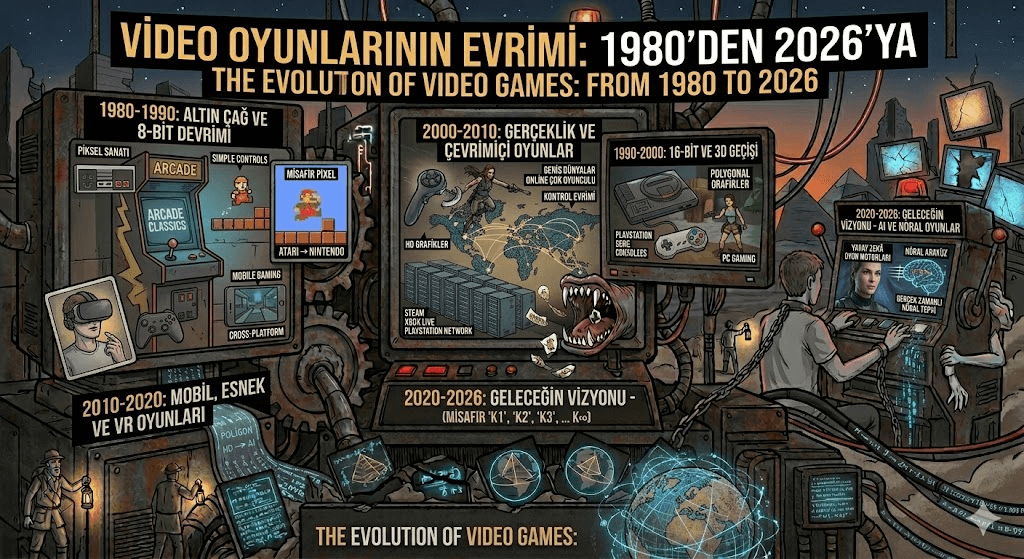


The evolution of video games: A journey through technology and culture
The evolution of video games from 1980 to 2026 is a remarkable story of innovation, where pixels evolved into photorealistic worlds and single-player adventures became global social experiences. This transformation was driven by breakthroughs in hardware, software, and connectivity, reshaping how millions interact with entertainment.
The evolution of video games in the early arcade era: Pixels, joysticks, and high scores
The evolution of video games began in earnest during the early 1980s, when arcades lit up malls and pizza parlors with neon lights and the unmistakable sound of Quick Guide Hub blips. Games like Pac-Man (1980) and Donkey Kong (1981) introduced characters that became cultural icons, proving that video games could be more than just a fad.
The birth of arcade culture and competitive play
Arcades fostered a new form of social interaction, where players gathered not just to play, but to compete for high scores and bragging rights. This era saw the rise of quarter-gobbling machines, with titles like Space Invaders (1978) and Galaga (1981) dominating the scene. The evolution of video games during this period was defined by simple mechanics paired with addictive gameplay loops.
Home consoles like the Atari 2600 bridged the gap between arcades and living rooms, though early limitations meant many games were stripped-down versions of their arcade counterparts. Despite this, the early 1980s laid the foundation for what would become a multi-billion-dollar industry.
Technical limitations and creative solutions
Limited processing power meant developers had to work within tight constraints. For example, Pac-Man’s maze was designed to maximize the use of the console’s 8-bit processor, while its ghosts were assigned distinct behaviors to simulate intelligence. These innovations proved that the evolution of video games wasn’t just about graphics—it was about clever programming and design.
The crash of 1983, triggered by market saturation and low-quality titles, nearly ended the industry. But companies like Nintendo, which released the Nintendo Entertainment System (NES) in 1985, revived consumer trust and set the stage for the next phase of the evolution of video games.

The evolution of video games through 8-bit and 16-bit eras: From 8-bit to Super Mario
By the mid-1980s, the evolution of video games accelerated with the arrival of 8-bit systems like the NES and Sega Master System. These consoles introduced more detailed graphics, richer soundtracks, and deeper gameplay, transforming video games from simple distractions into immersive experiences. The release of Super Mario Bros. in 1985 became a turning point, demonstrating how storytelling and level design could elevate a game.
Iconic franchises and the rise of Nintendo
Nintendo’s dominance in the 8-bit era was built on strong IP and innovative hardware. The NES introduced the world to Mario, Zelda, and Metroid—games that defined entire genres. Sega’s response, the Sega Genesis (1988), brought faster gameplay and edgier marketing, sparking the legendary “Genesis does what Nintendon’t” campaign. This rivalry pushed the evolution of video games forward, encouraging both companies to innovate.
This period also saw the introduction of save systems with battery backups, allowing players to continue their progress—an evolution in gameplay that made games more personal and replayable. Titles like The Legend of Zelda (1986) and Metroid (1986) introduced open-world exploration and non-linear progression, elements that remain staples today.
Sound, graphics, and the birth of cinematic storytelling
The 16-bit era, ushered in by the Super Nintendo (1990) and Sega Genesis, brought richer colors, smoother animation, and CD-quality audio. Games like Chrono Trigger (1995) and Final Fantasy VI (1994) used pre-rendered backgrounds and orchestral scores to create cinematic experiences. The evolution of video games during this time wasn’t just visual—it was narrative-driven.
RPGs gained traction as players sought deeper stories and character development, while fighting games like Street Fighter II (1991) and Mortal Kombat (1992) popularized competitive multiplayer. The 16-bit era proved that video games could be art, paving the way for the multimedia experiences we enjoy today.
The evolution of video games into 3D: From polygons to online worlds
The mid-1990s marked a pivotal shift in the evolution of video games: the move from 2D sprites to 3D polygons. This transition was led by the Sony PlayStation (1994), Sega Saturn, and Nintendo 64, each offering a different vision of 3D gaming. Games like Super Mario 64 (1996) and Tomb Raider (1996) redefined what was possible, introducing camera control and 3D movement that felt intuitive.
The rise of 3D platforms and immersive worlds
Super Mario 64 is often cited as the game that perfected 3D platforming. Its analog stick controls and open-ended level design allowed players to explore Princess Peach’s castle in ways that felt revolutionary. Meanwhile, Tomb Raider combined exploration, puzzle-solving, and action, creating a template for 3D adventure games. The evolution of video games now included a sense of physical space and depth.
This era also saw the introduction of voice acting and cinematic cutscenes, as seen in Metal Gear Solid (1998). These elements blurred the line between game and movie, enriching storytelling and emotional engagement. Players weren’t just controlling characters—they were inhabiting them.
Online connectivity and the dawn of multiplayer gaming
As the internet became more accessible, the evolution of video games took a social turn. The late 1990s and early 2000s saw the rise of online multiplayer with titles like Quake (1996) and EverQuest (1999). These games allowed players to connect globally, forming communities and battling or cooperating in real time. The concept of the “gamer” expanded beyond the solo enthusiast to include teams and guilds.
Microsoft’s Xbox (2001) integrated online play with Xbox Live, making multiplayer a core feature. This shift laid the groundwork for the connected gaming experiences we now take for granted, from MMORPGs to battle royale games.
The digital revolution in the evolution of video games: From discs to app stores
The mid-2000s brought another seismic shift in the evolution of video games: the transition from physical media to digital distribution. Xbox 360 (2005) and PlayStation 3 (2006) introduced online marketplaces like Xbox Live Arcade and the PlayStation Store, allowing players to download games instantly. This convenience democratized game development, giving indie creators a chance to reach global audiences.
The rise of digital storefronts and indie innovation
Platforms like Steam (2003) and the App Store (2008) further transformed the landscape. Indie titles such as World of Goo (2008) and Braid (2008) proved that creativity, not budget, could define success. The evolution of video games now included a thriving indie scene that challenged AAA conventions and introduced experimental gameplay.
Mobile gaming emerged as a dominant force with the launch of Apple’s iPhone (2007) and Google’s Android platform. Games like Angry Birds (2009) and Candy Crush Saga (2012) brought gaming to millions who had never owned a console or PC, broadening the audience dramatically. The evolution of video games was no longer confined to dedicated hardware.
Social gaming and the rise of microtransactions
Social media integration changed how games were shared and monetized. Facebook games like FarmVille (2009) introduced asynchronous multiplayer and viral growth mechanics. Meanwhile, free-to-play models with in-game purchases became standard, as seen in titles like League of Legends (2009) and Fortnite (2017). The evolution of video games now included economies built on virtual goods and live-service updates.
This era also saw the rise of esports, with games like League of Legends and Dota 2 turning competitive gaming into a spectator sport. Tournaments filled stadiums, and professional players became celebrities, further cementing the evolution of video games as a mainstream cultural phenomenon.
The modern evolution of video games: VR, AI, and the metaverse
From 2015 onward, the evolution of video games has been defined by three major forces: virtual reality (VR), artificial intelligence (AI), and the metaverse. The release of the Oculus Rift (2016), HTC Vive, and PlayStation VR brought immersive experiences to the mainstream, allowing players to step inside their favorite games. Meanwhile, AI-driven NPCs and procedural generation are creating dynamic, ever-changing worlds.
Virtual reality and immersive storytelling
VR games like Beat Saber (2018) and Half-Life: Alyx (2020) demonstrated the power of full-body immersion. Players weren’t just watching a screen—they were inside the game, physically moving and reacting. The evolution of video games into VR has opened new possibilities for education, training, and even therapy.
Augmented reality (AR) also gained traction with games like Pokémon GO (2016), blending digital content with the real world. This fusion of physical and virtual spaces redefined what it meant to “play” a game, making the evolution of video games more interactive and location-based.
AI, cloud gaming, and the future of play
Artificial intelligence is now being used to generate lifelike NPCs, adapt difficulty in real time, and even create entire game worlds. Games like The Last of Us Part II (2020) use AI to simulate realistic enemy behavior, while tools like NVIDIA’s DLSS use AI to enhance graphics without sacrificing performance. The evolution of video games is increasingly driven by intelligent automation.
Cloud gaming services like Xbox Cloud Gaming (2019) and NVIDIA GeForce Now (2020) are removing hardware barriers, allowing players to stream high-end games on low-end devices. This shift could democratize access to gaming even further, making the evolution of video games a truly global phenomenon.
The cultural and economic impact of the evolution of video games
The evolution of video games from 1980 to 2026 has reshaped entertainment, education, and even social interaction. No longer a niche hobby, gaming is now a $200 billion industry that rivals film and music in revenue and cultural influence. This transformation reflects how deeply the evolution of video games has penetrated daily life.
Gaming as a mainstream art form and storytelling medium
Games like The Last of Us (2013) and Red Dead Redemption 2 (2018) are celebrated for their narrative depth, character development, and emotional resonance. The evolution of video games into a storytelling medium has earned titles critical acclaim and awards traditionally reserved for cinema. Institutions like the Tribeca Film Festival now include game showcases, acknowledging the evolution of video games as an art form.
Moreover, games are being used to teach history, science, and language. Titles like Assassin’s Creed Discovery Tour (2018) and Minecraft: Education Edition (2016) leverage gameplay to create interactive learning experiences, proving that the evolution of video games extends far beyond entertainment.
The global economy and job creation
The gaming industry supports millions of jobs worldwide, from developers and designers to streamers and esports professionals. Esports alone generated over $1.3 billion in revenue in 2023, with tournaments broadcast to millions. The evolution of video games has also spawned related industries, including game journalism, merchandise, and virtual goods economies powered by blockchain and NFTs.
Moreover, gaming communities have become hubs for social connection, especially during the COVID-19 pandemic. Games like Among Us (2018) and Animal Crossing: New Horizons (2020) provided platforms for interaction, friendship, and even activism, showing how the evolution of video games fosters human connection in digital spaces.
Ready to dive deeper into gaming technology? Explore our complete guides on the evolution of video games and stay ahead of the next big trend. From retro classics to VR breakthroughs, we cover it all.
Learn more about the evolution of video games at Quick Guide Hub and become part of the next generation of gamers and creators.
Frequently Asked Questions
📚 Related Articles:
- How to start a successful YouTube channel in 2026: 7 Tips
- Best mobile applications of 2026 you must try 10
What were the most significant milestones in the evolution of video games from 1980 to 2026?
The evolution of video games saw its biggest milestones in the shift from 2D to 3D graphics, the rise of online multiplayer, the digital distribution revolution, and the emergence of VR and AI. Key moments include the release of Super Mario Bros. (1985), the launch of the PlayStation (1994), and the introduction of Fortnite (2017), each reshaping the industry’s trajectory.
How did the evolution of video games impact storytelling and character development?
The evolution of video games transformed storytelling from simple narratives to complex, cinematic experiences. Games like Final Fantasy VI (1994) and The Last of Us (2013) used emotional arcs and character depth to rival literature and film. Modern titles now feature branching storylines and player choices that affect outcomes, making the evolution of video games a driving force in interactive media.
What role did technology play in the evolution of video games?
Technology was the backbone of the evolution of video games, enabling advances in graphics, sound, AI, and connectivity. The transition from 8-bit processors to cloud computing and VR headsets reflects how hardware innovations unlocked new gameplay possibilities. Without Moore’s Law and the internet, the evolution of video games would have plateaued decades ago.
How did the evolution of video games influence other entertainment industries?
The evolution of video games has influenced film, music, and fashion, with franchises like Mario and Pokémon becoming global brands. Movies are now adapted from games, and game soundtracks top streaming charts. Esports and streaming have also created new entertainment formats, merging gaming with live performance and commentary.
What can we expect in the future of the evolution of video games by 2030?
By 2030, the evolution of video games is likely to be defined by fully realized metaverse experiences, brain-computer interfaces, and AI-generated game worlds. Cloud gaming will become seamless, and blockchain may enable true digital ownership of in-game assets. Expect games to blend with virtual reality, augmented reality, and even neural interfaces for unprecedented immersion.
Authoritative sources: Wikipedia and IETF.
Quick Reference Table
| Topic | Summary |
|---|---|
| The evolution of video games | Core concepts and practical tips |
| Audience | Beginners to advanced readers |
| Outcome | Actionable understanding |
