
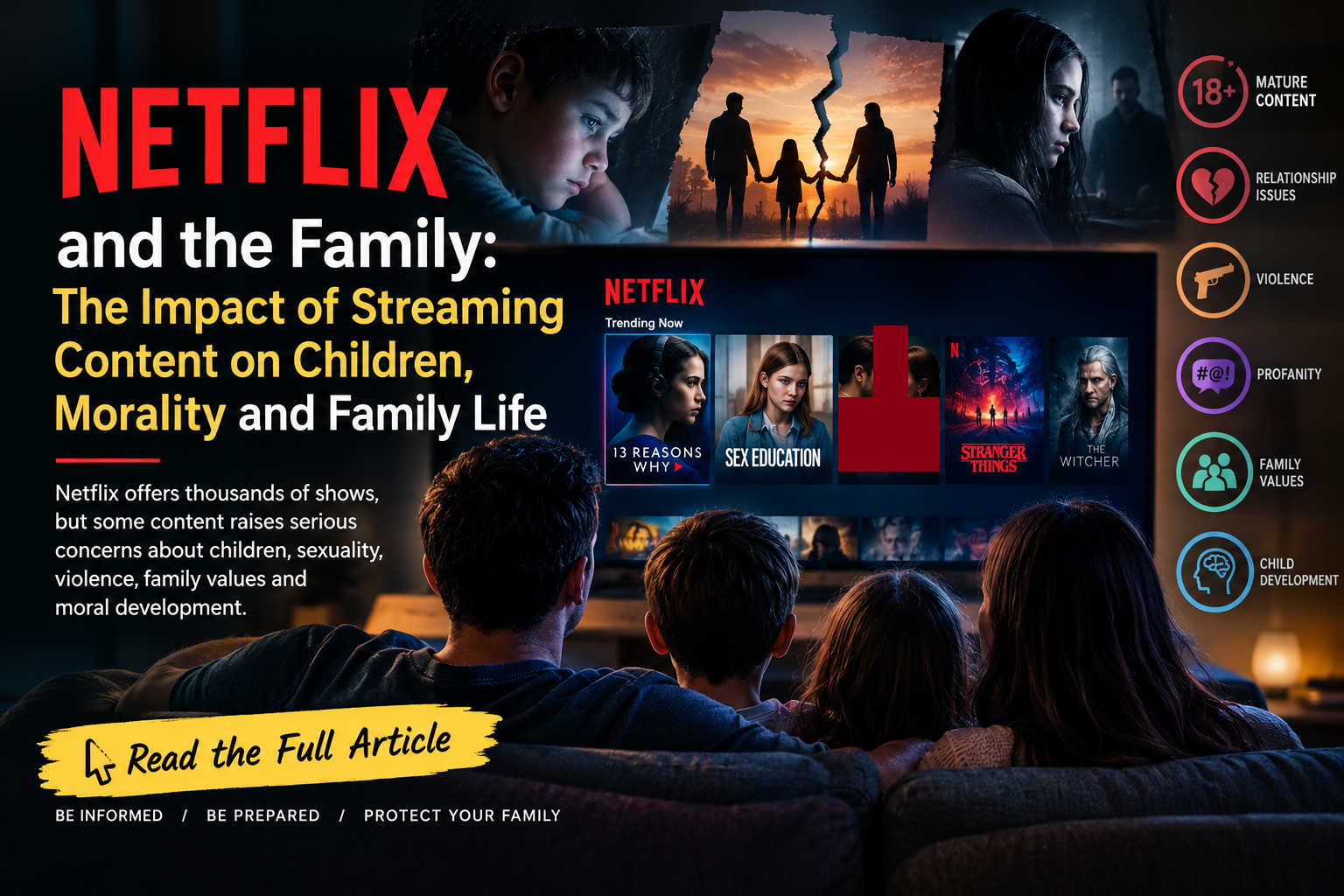

Netflix Has Changed the Way Families Watch Entertainment
Netflix has transformed entertainment by putting thousands of movies, television series and documentaries within immediate reach. With a phone, tablet, smart television or computer, a person can begin watching almost anything within seconds. For adults, this convenience may be entertaining and practical. For families, however, the same convenience creates an important question: What are children actually learning from the content they watch?
Netflix itself provides parental controls, children’s profiles, maturity ratings and title-blocking options. Its official help center explains that parents can create separate children’s profiles, set maturity limits, block individual titles, lock profiles and control autoplay settings.
The problem is therefore not simply the existence of Netflix. The deeper issue is how easily mature entertainment can become part of a child’s everyday environment when parents are not actively monitoring what is being watched.
Entertainment does not automatically determine a child’s character. Children are influenced by parents, school, friends, religion, culture, personal experiences and many other factors. Nevertheless, repeated exposure to particular ideas can influence what young people perceive as normal, desirable or acceptable.
This is why the discussion about Netflix deserves more than a simple question of whether a particular show is “good” or “bad.” The more important question is:
What values are repeatedly presented to children and teenagers, and how might those values influence their understanding of relationships, sexuality, violence, family and responsibility?
Netflix and the Normalization of Mature Content
One of the biggest concerns surrounding Netflix is the availability of mature material in a household where several people use the same account. A parent may believe that a teenager is watching an ordinary drama, only to discover that the program contains explicit sexual themes, strong language, drug references, violence or disturbing psychological material.
Netflix does provide maturity ratings, including categories such as TV-14 and TV-MA, and its rating system can identify content involving sex, language, violence and nudity. But a rating system is not the same thing as parental supervision.
Consider Big Mouth, for example. Common Sense Media rates the animated series for mature audiences and describes frequent sexual discussion, masturbation references, nudity, sexual humor and explicit language involving teenage characters.
The fact that something is animated can create a misleading impression. A parent might assume that an animated program is automatically appropriate for children. Yet animation is simply a storytelling technique. The themes themselves can still be highly mature. This creates an important challenge for families.
A child may see an animated character discussing sexuality and assume that the material is designed for children because of its cartoon appearance. Repeated exposure can gradually make subjects that parents would normally introduce carefully appear ordinary and harmless.
That does not mean every teenager who watches such content will experience psychological or behavioral problems. It means parents should not confuse entertainment with education.

Netflix, Sexual Content and the Developing Mind
Another major concern is the amount of sexual material available through Netflix. Shows such as Sex Education illustrate the issue particularly clearly. Common Sense Media rates the program for older audiences and describes frequent mature sexual content, nudity and strong language.
Supporters may argue that programs like this encourage conversations about relationships, puberty and sexuality. That argument should not simply be dismissed. Young people do need accurate and responsible information about relationships and human development. The important question is where that information comes from and how it is presented.
Entertainment frequently prioritizes humor, drama, excitement and emotional intensity. Real-life consequences may receive far less attention.
A teenager watching fictional relationships may encounter repeated messages suggesting that casual sexual relationships are normal, that physical attraction should guide major decisions, or that boundaries are obstacles to romantic fulfillment.
Research on adolescent exposure to pornography and sexual media has also raised concerns. A systematic review examining 19 studies found associations in several studies between pornography exposure and earlier sexual initiation, among other outcomes, while also noting the complexity of the evidence. The conclusion should not be that watching a particular Netflix series automatically produces harmful behavior.
The more reasonable concern is that repeated exposure to sexualized entertainment can become one influence among many in the formation of a young person’s attitudes toward intimacy and relationships.
Parents therefore have good reason to ask whether a particular program supports the values they want their children to develop.
Netflix and the Portrayal of Relationships
Entertainment can also influence how people understand romantic relationships.
A particularly controversial example is 365 Days, a film available through Netflix. Common Sense Media classifies the film as adult material and highlights graphic sexual content, violence and a storyline involving kidnapping, domination and coercive behavior. The concern here is not simply that the movie contains sexual material.
The deeper concern is the way certain relationship dynamics can be presented as romantic fantasy.
When controlling behavior, obsession, aggression or coercion are repeatedly placed inside a romantic storyline, viewers may become less sensitive to the difference between healthy affection and unhealthy control.
Healthy relationships require mutual respect, consent, trust, responsibility and emotional safety.
A dramatic story, however, may portray jealousy as proof of love, possessiveness as passion, or domination as attractiveness. For an emotionally mature adult, the fictional nature of the story may be obvious. For a teenager still developing an understanding of relationships, the distinction can be more difficult.
This is one reason parents should discuss entertainment rather than simply banning it.
Instead of saying only, “Do not watch this,” parents can ask:
- Is this relationship respectful?
- Does the character respect boundaries?
- Is controlling behavior being presented as romantic?
- Would this behavior be acceptable in real life?
- Does the story show the consequences of harmful decisions?
These questions turn entertainment into an opportunity for critical thinking.
Netflix and the Family Structure
The effect of streaming entertainment on family life is not limited to children. A family can spend hours in the same room while everyone is psychologically somewhere else. One person watches a series on a television. Another uses a phone. A teenager wears headphones. Parents scroll through social media. Everyone is physically present, but meaningful communication becomes increasingly limited.
This is where the problem becomes larger than Netflix itself.
The danger is not that watching a movie destroys a family. The danger is that passive entertainment can gradually replace active family interaction. Family life depends on conversation, shared meals, religious practices, outdoor activities, education, responsibilities and emotional connection.
If every quiet moment is filled with another episode, another movie or another recommended title, there may be fewer opportunities for parents and children to talk. Autoplay can make this pattern particularly easy to continue. Netflix provides controls allowing parents to turn autoplay features on or off, which shows why these settings can be useful for families.
A simple decision such as “one episode before bed” can easily become “one more episode.” The problem is not entertainment itself.
The problem is when entertainment becomes the default activity instead of one activity among many.

Netflix and Children: Why Parents Need to Pay Attention
Children are especially vulnerable to inappropriate content because their emotional, social and cognitive development is still progressing. A child may understand that a fictional character is not real, but that does not mean the child automatically understands the values communicated by the story.
For example, a child may repeatedly see characters solving problems through aggression. Another may see adults treating alcohol as normal entertainment. Another may see relationships built around physical attraction rather than responsibility.
Over time, these repeated messages can become familiar. That is why Netflix parental controls are important. Parents can create children’s profiles, establish maturity limits and block specific titles. Netflix also provides profile locks and PIN-related controls.
However, technology cannot replace parenting. A parental control system can prevent access to some material, but it cannot explain why certain behavior is unhealthy.
A child needs both protection and guidance. Protection means preventing inappropriate exposure. Guidance means teaching children how to evaluate what they see.
Netflix and the Case of 13 Reasons Why
One of the strongest examples of the potential risks of entertainment content for young people is 13 Reasons Why.
The series addressed suicide, bullying, sexual assault and adolescent mental health. Some people argued that the program encouraged important conversations about difficult subjects. Others raised serious concerns about how suicide was portrayed.
Common Sense Media describes the series as intense and disturbing, with themes involving suicide, sexual content, profanity and sexual assault. More importantly, academic research investigated whether the release of the series was associated with changes in youth suicide rates.
One study published in JAMA Psychiatry found an association between the release of the series and an increase in monthly suicide rates among U.S. youth aged 10–17.
Another study reported an increase in observed suicides among young people aged 10–19 in the months following the release and said the pattern was consistent with possible media contagion, while cautioning about interpretation.
However, the scientific discussion is not completely one-sided. A later study argued that seasonal patterns and other factors could explain at least some of the previously observed association.
This distinction is important. It would be irresponsible to say that Netflix “caused” young people to die by suicide.
A more accurate conclusion is that the portrayal of suicide in popular entertainment can create legitimate risks for vulnerable viewers and therefore requires exceptional care.
In fact, Netflix later edited the original graphic suicide scene following consultation with suicide-prevention experts and doctors.
This example demonstrates why parents should not assume that popularity equals safety.
Netflix and the Desensitization to Violence
Sexual content is not the only concern. Many popular streaming productions contain violence, murder, weapons, torture and psychological cruelty. Violence is a legitimate part of storytelling in many circumstances. Historical dramas, war movies and crime stories can explore serious subjects meaningfully.
But repetition changes the experience. When violence is repeatedly used as entertainment, viewers may gradually become less emotionally responsive to it.
Children may also struggle to distinguish between realistic consequences and fictional entertainment. A character can be shot, injured or killed in one scene and disappear from the story shortly afterward. Real life does not work that way.
This distinction is particularly important when young viewers consume violent content without an adult available to explain what they are seeing. Parents should therefore consider not only whether a Netflix program contains violence but also how the violence is portrayed.
Is violence condemned?
Are victims treated with dignity?
Are consequences shown?
Does the story glorify revenge?
Does the protagonist solve every problem through aggression?
These questions are much more useful than simply counting violent scenes.
Netflix, Language and Moral Habits
Another issue is language. Many modern television dramas normalize profanity to such an extent that strong language becomes part of ordinary dialogue.
A teenager who repeatedly hears insults, profanity and sexually explicit language may begin to perceive that language as normal adult communication.
Again, this does not mean one episode automatically changes a child’s vocabulary. The concern is repetition. Children learn through imitation. They listen to parents, friends, teachers and media characters.
When a popular character uses offensive language while being portrayed as intelligent, attractive, funny or successful, the language can become associated with positive characteristics.
This is why parents should pay attention to the entire package of a program rather than focusing only on its plot. A technically interesting story can still contain messages that a particular family does not want normalized in the home.

Netflix Is Not the Only Problem
It is important to make one point clear: Netflix is not the only source of these concerns.
YouTube, TikTok, social media, television, video games and other streaming services can contain similar material.
Blaming one company for every problem facing modern families would be simplistic.
The broader issue is the digital entertainment environment.
Modern children can access enormous amounts of information before they have developed the maturity to evaluate it.
The responsibility therefore belongs partly to technology companies, but also to parents, educators and society.
Netflix provides parental controls. Parents have the responsibility to use them.
Netflix provides maturity ratings. Parents should read them.
Netflix provides children’s profiles. Parents can create them.
Netflix provides title-blocking tools. Parents can use them.
But parents also need to know what their children are watching.
How Parents Can Use Netflix More Safely
Families do not necessarily need to eliminate Netflix completely.
Instead, parents can establish clear rules.
1. Create a separate children’s profile
Netflix specifically provides a children’s experience designed to limit content to age-appropriate selections.
2. Use maturity restrictions
Do not rely only on the title or promotional image.
Check the maturity rating and content warnings.
3. Disable autoplay
If the family watches one episode, allow the family to make a conscious decision about whether to watch another.
4. Keep devices out of bedrooms
A common family rule can be that entertainment devices remain in shared areas.
5. Watch important programs together
If a teenager wants to watch a controversial series, consider watching it together.
6. Talk about difficult themes
Ask what the teenager thinks about the characters and their decisions.
7. Teach values before banning content
A child who understands why something is harmful is better prepared to make responsible decisions later.
Netflix Can Become an Opportunity for Family Discussion
There is another side to the discussion. A difficult Netflix program can sometimes become an opportunity for parents to teach important values. A story about bullying can lead to a conversation about kindness. A story about addiction can lead to a discussion about self-control.
A story about broken families can lead to a discussion about responsibility. A story involving unhealthy relationships can help parents explain respect, boundaries and consent.
The key is active parenting. When children watch everything alone, the media becomes the teacher. When parents watch selectively and discuss what they see, entertainment becomes a starting point for education.
This is a major difference.
What Should Families Ask Before Watching Netflix?
Before pressing play, parents can ask five simple questions:
Is this appropriate for my child’s age?
Does this content reflect values we want to reinforce?
Could the subject matter be emotionally disturbing?
Does the program present harmful behavior as attractive or normal?
Will watching this program improve our family time or replace it?
These questions can prevent many problems before they begin. The goal should not be to create an environment where children never encounter difficult ideas.
The goal should be to make sure children encounter those ideas with the maturity, guidance and context necessary to understand them.

Final Thoughts: Netflix Requires Responsible Parenting
Netflix has brought enormous convenience to entertainment. It can provide educational documentaries, family movies, historical productions, inspiring stories and high-quality programs.
At the same time, the platform also contains mature material involving sexuality, violence, profanity, substance use, suicide and unhealthy relationships. The existence of such content does not automatically make Netflix harmful.
The real concern is uncontrolled access and repeated exposure, especially among children and young teenagers.
Parents should therefore avoid two extremes. The first extreme is allowing children unlimited access without supervision. The second is assuming that every program is dangerous simply because it comes from a streaming platform.
A balanced approach is more effective. Use parental controls. Check ratings. Watch programs together. Discuss difficult themes. Set time limits. Protect bedrooms and family meals from becoming extensions of the streaming screen. Most importantly, remember that entertainment should serve family life—not replace it.
Netflix can be a useful entertainment tool when used responsibly. But when mature content, endless autoplay and unsupervised viewing become routine, families may need to reconsider how much influence streaming entertainment has inside the home.
The most important parental control is not a button on a screen. It is an involved parent.
A Simple CTA for Parents
Before your child watches another series, take two minutes to check its age rating, themes and content warnings. A small decision today can make a big difference in what your child considers normal tomorrow.
Talk. Watch together. Set boundaries. Protect your family.