
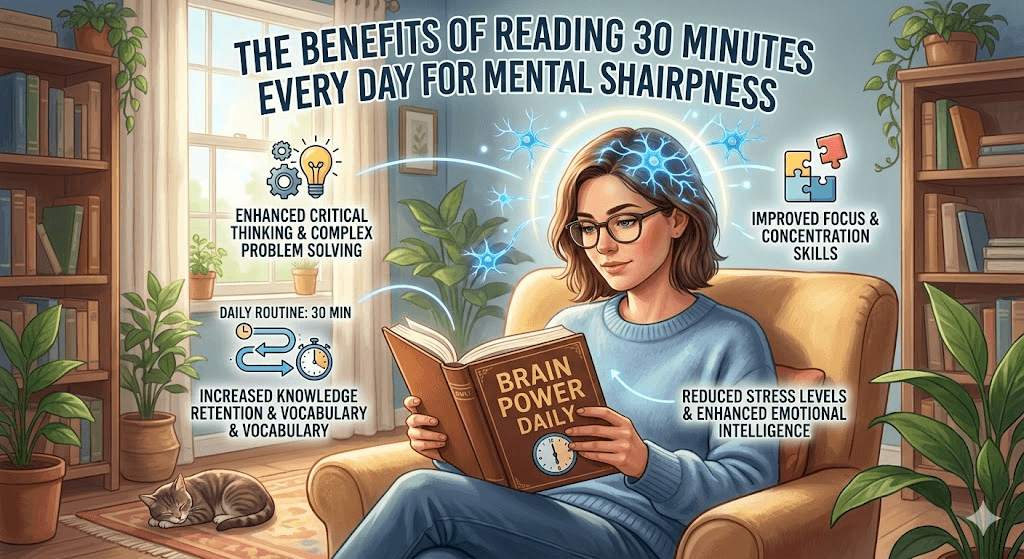


The benefits of reading 30 minutes every day for mental sharpness: The benefits of reading minutes
The benefits of reading minutes — The benefits of reading 30 minutes every day extend far beyond passive entertainment—they actively reshape your brain, enhance cognitive function, and improve overall mental sharpness. When you dedicate just half an hour to reading daily, you’re not just passing time; you’re building neural pathways that boost memory, focus, and critical thinking skills over time.
The benefits of reading 30 minutes every day for cognitive enhancement
One of the most compelling benefits of reading 30 minutes every day is its direct impact on cognitive enhancement. Studies show that regular reading strengthens the prefrontal cortex—the area responsible for decision-making and complex reasoning. Unlike passive screen time, reading demands active engagement with new vocabulary, complex sentence structures, and logical arguments, which stimulates brain plasticity and slows cognitive decline.
Moreover, daily readers often experience improved concentration spans. In a world dominated by fragmented attention spans from social media and notifications, 30 minutes of focused reading trains the mind to sustain attention for longer periods. Children who read daily show enhanced academic performance, while adults maintain sharper memory retention and quicker information processing.
Boosting memory retention with daily reading
When you read consistently, your brain forms new neural connections that strengthen memory pathways. Each time you encounter unfamiliar words or concepts, your hippocampus—the brain’s memory center—gets activated to store and retrieve that information later. This process is similar to how physical exercise builds muscle strength; reading daily acts as a mental workout that enhances both short-term recall and long-term retention.
Enhancing analytical thinking through structured content
Unlike passive entertainment, reading—especially non-fiction—requires you to follow arguments, evaluate evidence, and draw conclusions. This constant mental exercise sharpens your analytical thinking skills, making it easier to solve problems in both personal and professional contexts. Whether you’re analyzing a business case study or debating a philosophical idea, the benefits of reading 30 minutes every day translate directly into better critical thinking abilities.

The benefits of reading 30 minutes every day for emotional wellbeing
The benefits of reading 30 minutes every day aren’t limited to intellectual growth—they profoundly impact emotional health as well. Reading serves as a therapeutic escape from daily stressors, offering a safe space to process emotions, gain perspective, and cultivate empathy. Unlike passive scrolling or binge-watching, reading immerses you in someone else’s experiences, fostering emotional intelligence and reducing feelings of isolation.
Reducing stress and anxiety through immersive reading
Research from the University of Sussex found that reading can reduce stress levels by up to 68%—more effectively than listening to music or going for a walk. The reason lies in the way reading slows heart rate and eases muscle tension. When you lose yourself in a good book, your mind enters a state similar to meditation, where worries temporarily fade. This mental reset is one of the most undervalued benefits of reading 30 minutes every day for modern life.
Building emotional resilience and empathy
Fiction, in particular, exposes readers to diverse perspectives, cultures, and life situations they might never encounter otherwise. This exposure fosters empathy by helping readers understand different viewpoints, a skill increasingly valuable in our interconnected world. Additionally, biographies and self-help books provide real-life examples of resilience, teaching readers how to navigate challenges with greater emotional stability. The benefits of reading 30 minutes every day thus extend from personal growth to stronger social connections.
How the benefits of reading 30 minutes every day boost productivity and success
One of the most practical benefits of reading 30 minutes every day is its ability to supercharge productivity. Unlike multitasking or reactive work habits, reading fosters deep focus—a skill that translates directly into higher efficiency in other areas of life. When you train your brain to concentrate on a single task (reading) for 30 minutes, you’re effectively building mental discipline that spills over into your work and daily responsibilities.
Career and professional growth through consistent reading
In today’s knowledge-driven economy, continuous learning is no longer optional—it’s essential. Professionals who read daily gain a competitive edge by staying updated on industry trends, expanding their skill sets, and gaining insights from experts in their fields. A study by PwC found that employees who engage in regular learning through reading are 23% more likely to advance in their careers. The benefits of reading 30 minutes every day thus include faster promotions, better job performance, and increased earning potential.
Efficient learning techniques unlocked by daily reading
Reading daily doesn’t just make you smarter—it makes you a more efficient learner. When you consistently consume well-structured content, you train your brain to absorb information faster and retain it longer. This skill is invaluable in today’s fast-paced world, where the ability to quickly learn new concepts often determines success. For example, software developers who read technical documentation daily master new programming languages faster than those who rely solely on trial and error. Similarly, meditation combined with daily reading has been shown to improve focus and retention even further.
Practical ways to start your 30-minute reading habit
Understanding the benefits of reading 30 minutes every day is one thing—actually implementing the habit is another. The key to success lies in strategic planning, eliminating distractions, and choosing the right reading material. Without a clear plan, even the most motivated individuals can struggle to maintain consistency. Below, we’ll explore actionable strategies to help you build and sustain this powerful habit.
Morning vs. evening reading sessions: Which is better?
Both morning and evening reading have unique advantages, and the best time depends on your personal rhythm and goals. Morning readers often report feeling more focused and productive throughout the day, as reading primes the brain for learning and problem-solving. Research from Harvard Business Review supports this, showing that early risers who engage in deep work (like reading) before checking emails or social media experience higher levels of success.
On the other hand, evening reading serves as a wind-down ritual that separates work from personal time, reducing stress and improving sleep quality. The benefits of reading 30 minutes every day in the evening include lower cortisol levels and a calmer mind before bedtime. Experiment with both timings to find what works best for your schedule and energy levels.
Choosing the right books for maximum benefit
Not all reading material delivers the same benefits of reading 30 minutes every day. To maximize cognitive and emotional gains, prioritize books that challenge your thinking or align with your goals. Non-fiction books on psychology, business, or science expand your knowledge base, while fiction improves creativity and empathy. For professional growth, consider industry-specific books or biographies of successful individuals in your field.
Avoid passive reading material like light magazines or social media feeds that don’t require deep engagement. Instead, opt for books with complex ideas, well-researched arguments, or thought-provoking narratives. Tools like Goodreads or Blinkist can help you curate high-quality reading lists tailored to your interests and learning objectives.
| Reading Time | Primary Benefit | Long-Term Impact |
|---|---|---|
| 10 minutes | Immediate stress relief | Builds short-term focus |
| 20 minutes | Enhanced memory retention | Strengthens neural pathways |
| 30 minutes | Cognitive enhancement & empathy | Long-term brain health & emotional intelligence |
| 45+ minutes | Deep learning & skill mastery | Expert-level knowledge retention |
Science-backed evidence supporting the benefits of reading 30 minutes every day
The benefits of reading 30 minutes every day aren’t just anecdotal—they’re backed by extensive scientific research. Neuroscientists have long studied how reading affects the brain, and the results are compelling. A 2019 study published in the journal *Brain Connectivity* found that regular reading increases connectivity in the left temporal cortex, a region associated with language and semantic processing. This suggests that daily readers develop stronger linguistic and analytical skills over time.
Neuroscientific proof of brain enhancement
Researchers at Emory University discovered that reading fiction can increase activity in the default mode network (DMN), the brain region responsible for imagination and empathy. When participants read a novel, their brains showed heightened connectivity in this network for days afterward, indicating that reading leaves a lasting imprint on cognitive function. This explains why avid readers often report feeling more empathetic and emotionally intelligent after prolonged reading sessions.
Long-term cognitive health benefits
A study from Rush University Medical Center followed elderly individuals for six years and found that those who read regularly experienced slower rates of cognitive decline compared to non-readers. The protective effects were particularly strong for those who engaged in daily reading, demonstrating that the benefits of reading 30 minutes every day extend well into old age. This research underscores reading as a powerful tool for preventing dementia and maintaining brain health.
External studies also support the cognitive benefits of daily reading. A 2020 meta-analysis from the *Journal of Experimental Psychology* confirmed that regular readers exhibit superior working memory, processing speed, and verbal fluency compared to their non-reading peers. These findings highlight reading as a low-cost, high-reward activity for lifelong brain maintenance.

Common misconceptions about daily reading habits
Despite the overwhelming evidence supporting the benefits of reading 30 minutes every day, several myths persist about what makes a reading habit effective. Addressing these misconceptions can help you avoid frustration and build a sustainable practice. Below, we debunk the most common myths to clarify what truly matters when it comes to daily reading.
Myth 1: “You need to read complex or classic books to benefit”
Many people believe that only highbrow literature or academic texts deliver real value, but this couldn’t be further from the truth. The benefits of reading 30 minutes every day come from consistent engagement with language, not the difficulty of the material. Even light fiction, self-help books, or industry magazines can improve vocabulary, reduce stress, and enhance cognitive function. What matters most is that you enjoy what you’re reading and stay engaged.
Myth 2: “You must finish every book you start”
Another pervasive myth is the idea that abandoning a book is a sign of failure. In reality, the benefits of reading 30 minutes every day are about the act of reading itself, not the completion of books. If a book isn’t resonating with you after several chapters, it’s perfectly fine to set it aside and pick up something more aligned with your interests. Quality matters more than quantity, and forcing yourself to finish an unengaging book can actually reduce the habit’s long-term benefits.
Myth 3: “Reading is only beneficial if you take notes or apply what you learn”
The benefits of reading: While active reading (like note-taking or applying concepts) can enhance retention, it’s not a prerequisite for gaining the benefits of reading 30 minutes every day. Simply immersing yourself in a well-written narrative or absorbing new ideas passively still stimulates the brain and improves cognitive function. Over time, these passive benefits accumulate, making reading one of the most accessible paths to lifelong learning and mental agility.
Ready to transform your life with the power of daily reading? Start your 30-minute habit today and unlock the proven benefits of reading 30 minutes every day for sharper focus, reduced stress, and greater success. For more life-changing habits, explore our guide on quickguidehub and discover how small daily actions lead to extraordinary results.
Statistical Data: The benefits of reading 30 minutes every day
Frequently Asked Questions
📚 Related Articles:
Can I still get the benefits of reading 30 minutes every day if I read on a screen instead of paper?
The benefits of reading 30 minutes every day apply regardless of the medium, though paper books have slight advantages in retention and comprehension. Studies show that readers absorb information better from physical books due to fewer distractions and better spatial memory cues. However, e-readers and tablets still provide significant cognitive and emotional benefits, especially if you use features like highlighting or note-taking to stay engaged.
What types of books should I read to maximize the benefits of reading 30 minutes every day?
To get the most out of your reading time, mix genres based on your goals. For cognitive enhancement, opt for non-fiction on psychology, science, or business. For emotional wellbeing, fiction and biographies build empathy and resilience. If productivity is your focus, read books on habit formation or skill development. The key is to choose material that challenges you without causing frustration.
How long does it take to see the benefits of reading 30 minutes every day?
While some benefits, like reduced stress, can be felt immediately, most cognitive and emotional improvements from the benefits of reading 30 minutes every day become noticeable after 3-4 weeks of consistent practice. Memory enhancement and improved focus typically appear within a month, while long-term brain health benefits may take several months to manifest. The key is consistency—make reading a non-negotiable part of your daily routine.
Is it better to read in one sitting or split the 30 minutes into shorter sessions?
Both approaches work, but one continuous session tends to provide deeper cognitive engagement. Splitting the time can be useful if you struggle with focus, but research shows that uninterrupted reading sessions of 20-30 minutes yield the best results for comprehension and retention. If you prefer shorter sessions, aim for at least two 15-minute blocks with focused attention.
Can the benefits of reading 30 minutes every day be replicated by listening to audiobooks?
The benefits of reading: While audiobooks offer convenience and accessibility, they don’t provide the same cognitive benefits as silent reading. Audiobooks engage auditory processing rather than the deep neural connections formed during silent reading. However, they can complement your reading habit, especially during commutes or workouts. For maximum cognitive gains, prioritize silent reading when possible, but don’t dismiss audiobooks entirely—they still offer stress relief and exposure to new ideas.